Showing posts with label hammurabi. Show all posts

Saturday, January 23, 2010

Day 23. Exodus 19-21

Exodus 19-21

Exodus 19

1In the third month, when the children of Israel were gone forth out of the land of Egypt, the same day came they into the wilderness of Sinai.

It's only been 3 months. The people were probably wondering how long they would be in the wilderness for.

Next station is the Sinai wilderness.

3And Moses went up unto God, and the LORD called unto him out of the mountain, saying, Thus shalt thou say to the house of Jacob, and tell the children of Israel;

This place is where a lot of things happened.

5Now therefore, if ye will obey my voice indeed, and keep my covenant, then ye shall be a peculiar treasure unto me above all people: for all the earth is mine:

Is this a new covenant? We've had the Noah Covenant, and the Abram Covenant (passed to Isaac), the Jacob Covenant. "If ye will ... keep my covenant". The people didn't really have to do anything at this point to keep the covenant. About the only thing demanded of them from the previous covenants (other than the 7 Noahide laws) was circumcision.

Moses goes and tells the elders what God said, which really wasn't very much.

9And the LORD said unto Moses, Lo, I come unto thee in a thick cloud, that the people may hear when I speak with thee, and believe thee for ever. And Moses told the words of the people unto the LORD.

God said they would hear when he speaks, it didn't say they would be able to understand him.

11And be ready against the third day: for the third day the LORD will come down in the sight of all the people upon mount Sinai.

Nobody knows where mount Sinai is.

12And thou shalt set bounds unto the people round about, saying, Take heed to yourselves, that ye go not up into the mount, or touch the border of it: whosoever toucheth the mount shall be surely put to death:

13There shall not an hand touch it, but he shall surely be stoned, or shot through; whether it be beast or man, it shall not live: when the trumpet soundeth long, they shall come up to the mount.

God actively killed Er and Onan, he now needs people to either stone, or shoot (arrows) people who disobey him.

16And it came to pass on the third day in the morning, that there were thunders and lightnings, and a thick cloud upon the mount, and the voice of the trumpet exceeding loud; so that all the people that was in the camp trembled.
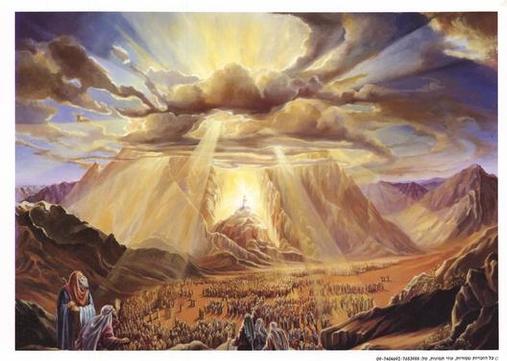
17And Moses brought forth the people out of the camp to meet with God; and they stood at the nether part of the mount.

Why god needed to showboat with the thunders and lightnings is unknown. He was leading them with the smoke and with the fire. Why did he now need to show off with a big godlike display?

20And the LORD came down upon mount Sinai, on the top of the mount: and the LORD called Moses up to the top of the mount; and Moses went up.

At the top, god told Moses that the people weren't supposed to go up to the mountain, and that the priests aren't supposed to either. Then he said for Moses to bring Aaron up.

Exodus 20

2I am the LORD thy God, which have brought thee out of the land of Egypt, out of the house of bondage.

Guess what we've got now... that's right, the 10 commandments.

3Thou shalt have no other gods before me.

The Decalogue is one of my favorite parts of the bible. Exactly why, I'm not sure. I just love the way that it has been manipulated to mean so many different things.

Commandment #1. Thou shalt have no other gods before me.

Oddly, me isn't capitalized.

4Thou shalt not make unto thee any graven image, or any likeness of any thing that is in heaven above, or that is in the earth beneath, or that is in the water under the earth.

5Thou shalt not bow down thyself to them, nor serve them: for I the LORD thy God am a jealous God, visiting the iniquity of the fathers upon the children unto the third and fourth generation of them that hate me;

6And shewing mercy unto thousands of them that love me, and keep my commandments.

Commandment #2. No graven images.

7Thou shalt not take the name of the LORD thy God in vain; for the LORD will not hold him guiltless that taketh his name in vain.

Commandment #3. No taking the name of the LORD in vain. God's name isn't god. This references the YHVH (Jehovah) name. Jews won't even write God, they put G-d, for fear of breaking this commandment.

8Remember the sabbath day, to keep it holy.

Commandment #4. Remember the sabbath.

12Honour thy father and thy mother: that thy days may be long upon the land which the LORD thy God giveth thee.

Commandment #5. Honor thy father and thy mother.

13Thou shalt not kill.

Commandment #6. Thou shalt not kill.

14Thou shalt not commit adultery.

Commandment #7. Thou shalt not commit adultery.

15Thou shalt not steal.

Commandment #8. Thou shalt not steal.

16Thou shalt not bear false witness against thy neighbour.

Commandment #9. Thou shalt not bear false witness.

17Thou shalt not covet thy neighbour's house, thou shalt not covet thy neighbour's wife, nor his manservant, nor his maidservant, nor his ox, nor his ass, nor any thing that is thy neighbour's.

Commandment #10. Thou shalt not covet.

The Catholics take out #2, because they really like their graven images. Then they split #10 into two.

What do those mean? The first four commandments deal with worshiping god. The final are laws for living in an organized society. You'll note that most of the laws deal with the "neighbor". Who is the neighbor? The neighbor is someone just like you. To them, it was a fellow Hebrew. Somone who left Egypt with them. People who had gone through the exact same thing.

Commandment #6, is a prohibition against murder. It doesn't mean don't kill anyone ever. How can you know that it doesn't mean don't kill anyone ever? Later we'll see the punishments for breaking these laws, most of them carry the death sentence. If you can't kill, you can't have a death penalty.

22And the LORD said unto Moses, Thus thou shalt say unto the children of Israel, Ye have seen that I have talked with you from heaven.

Moses makes sure to let the people know that it was god who spoke to him, and that they all saw it.

Exodus 21

Now we get some more laws.

2If thou buy an Hebrew servant, six years he shall serve: and in the seventh he shall go out free for nothing.

A Hebrew slave can only be in your care for 6 years. After that, he is released. If he was married when purchased, then the wife can leave with him. If the master gives him a wife, then the wife and all kids belong to the master.

5And if the servant shall plainly say, I love my master, my wife, and my children; I will not go out free:

6Then his master shall bring him unto the judges; he shall also bring him to the door, or unto the door post; and his master shall bore his ear through with an aul; and he shall serve him for ever.

If you love your master, you will be nailed to a door. Did they have doors while wandering around in the wilderness?

7And if a man sell his daughter to be a maidservant, she shall not go out as the menservants do.

You can sell your daughter. She doesn't count to the 7th year freedom thing.

The master can't sell her to foreigners. (Was this a problem wandering around in the wilderness)? If he bought her for his son, he has to treat her like a daughter. If he has another wife, she can't have less of a role as a wife.

12He that smiteth a man, so that he die, shall be surely put to death.

If you hit a person to death, you will be killed. Remember the "thou shalt not kill" commandment. If you break it, you get put to death.

15And he that smiteth his father, or his mother, shall be surely put to death.

If you hit your father or mother, you will be killed.

16And he that stealeth a man, and selleth him, or if he be found in his hand, he shall surely be put to death.

Kidnapping is punishable by death.

17And he that curseth his father, or his mother, shall surely be put to death.

It's not bad enough to just HIT your parent's if you curse them, you get the death penalty.

If two guys fight, and one gets injured but survives, you only have to pay lost wages.

If a man hits his servant, and it dies, the guy will be punished; however, if he doesn't die, you can beat him all you want.
21Notwithstanding, if he continue a day or two, he shall not be punished: for he is his money.

"He is his money". That's an awesome phrase. It means the slave is property. It's not a person, it's property.

22If men strive, and hurt a woman with child, so that her fruit depart from her, and yet no mischief follow: he shall be surely punished, according as the woman's husband will lay upon him; and he shall pay as the judges determine.

Why is a pregnant woman watching men fight?

24Eye for eye, tooth for tooth, hand for hand, foot for foot,

Where have I heard "eye for eye" before? Oh yeah, the Code of Hammurabi. Remember, Hammurabi was probably one of the kings who took Lot. Eye for an eye is Code # 196.

Next is some laws that deal with ox. We don't really need to know those because... I don't have any oxen, and don't know anyone that has some. If you do need to know these because you have had incidents with ox, let me know.

Points to ponder:

1. Why did god make such a big show up on the mountain with thunder and lightning?

2. Why did god have to threaten people with death, why not just actually kill them? What's funny is the people were threatened with being stoned for touching the mount, meanwhile they were threatened with being killed because if they saw god, they would die.

3. Are the ten commandments actually good rules for society? Are these actually the ten commandments that are on the tablets? You'll note, the word tablet wasn't used yet.

4. Are these laws all stolen from the Code of Hammurabi? Was Moses taught these laws while he was being schooled as an Egyptian Noble?

Wednesday, January 6, 2010

Day 5. Genesis 13-15

Genesis 13-15

Genesis 13

1And Abram went up out of Egypt, he, and his wife, and all that he had, and Lot with him, into the south.

2And Abram was very rich in cattle, in silver, and in gold.

Apparently the drought had ended. We aren't told exactly how long Abram stayed in Egypt.

3And he went on his journeys from the south even to Bethel, unto the place where his tent had been at the beginning, between Bethel and Hai;

Oh hai, welcome to Bethel. Bethel means "House of El" (El is another name for god). Edward Robinson believed that Bethel is now Beitin. There are some significant things that wind up happening at Bethel. It may or may not be the same place. Pretty much anywhere that someone encounters the old testament god, can be named Beth El.

5And Lot also, which went with Abram, had flocks, and herds, and tents.

6And the land was not able to bear them, that they might dwell together: for their substance was great, so that they could not dwell together.

Lot was traveling with Abram. They were a rather large group.

7And there was a strife between the herdmen of Abram's cattle and the herdmen of Lot's cattle: and the Canaanite and the Perizzite dwelled then in the land.

Lot and Abram weren't fighting, but their workers were fighting over who would get the best land/watering holes/places to stay.

Abram offers Lot a choice.

9Is not the whole land before thee? separate thyself, I pray thee, from me: if thou wilt take the left hand, then I will go to the right; or if thou depart to the right hand, then I will go to the left.

If you take the left, I'll take the right.

10And Lot lifted up his eyes, and beheld all the plain of Jordan, that it was well watered every where, before the LORD destroyed Sodom and Gomorrah, even as the garden of the LORD, like the land of Egypt, as thou comest unto Zoar.

11Then Lot chose him all the plain of Jordan; and Lot journeyed east: and they separated themselves the one from the other.

Here we see some foreshadowing. The towns of Sodom and Gomorrah were mentioned earlier in Gen 10:19. Their destruction hasn't been brought up yet.

12Abram dwelled in the land of Canaan, and Lot dwelled in the cities of the plain, and pitched his tent toward Sodom.

Lot moved into town. Abram stayed as a vagabond rancher. We aren't told what happened to all those herdmen who worked for Lot.

13But the men of Sodom were wicked and sinners before the LORD exceedingly.

Men of Sodom. This is where the term sodomy comes from. Sodomy covers anal intercourse, oral intercourse, and bestiality.

14And the LORD said unto Abram, after that Lot was separated from him, Lift up now thine eyes, and look from the place where thou art northward, and southward, and eastward, and westward:

15For all the land which thou seest, to thee will I give it, and to thy seed for ever.

Here we have another covenant between god and a human.

16And I will make thy seed as the dust of the earth: so that if a man can number the dust of the earth, then shall thy seed also be numbered.

That's a lot of offspring.

18Then Abram removed his tent, and came and dwelt in the plain of Mamre, which is in Hebron, and built there an altar unto the LORD.

Abram will stay at Mamre for a while.

Genesis 14

1And it came to pass in the days of Amraphel king of Shinar, Arioch king of Ellasar, Chedorlaomer king of Elam, and Tidal king of nations;

This should give an exact date.

Amraphel of Shinar. Shinar is a name for Mesopotamia or Babylon. Amraphel is associated with Hammurabi. Drop the H and BI in Hammurabi; drop the EL in Amraphel and you are left with Ammura and Amraph respectively. Remember EL normally means God (beth el). Hammurabi was king of Babylon from 1792 to 1750 BC.

Arioch king of Ellasar. It is believed this is Eri-aku king of Larsa (Assyria).

Chedorlaomer king of Elam. It is believed this is Kudur-Lagamar king of Elam. Others believe it is Kutir-Lagamar.

Tidal king of nations. Tudhaliya was the name of several Hittite kings. They ruled from the 1430s to the 1100's. It wouldn't have been any of them. Bestowing the title of Tidal (Tudhaliya) would have been because at the time, the Hittite kingdom had several nations involved, Ammurru and Mittani.

With the kings named, it is still impossible to put an exact date of this event.

2That these made war with Bera king of Sodom, and with Birsha king of Gomorrah, Shinab king of Admah, and Shemeber king of Zeboiim, and the king of Bela, which is Zoar.

The first four kings attacked the kings of these cities: Sodom, Gomorrah, Admah, Zeboiim, and Bela. The historicity of these kings is doubtful.

3All these were joined together in the vale of Siddim, which is the salt sea.

The battle of the Vale of Siddim! Did it happen?

According to Genesis 14, the kings in verse 2 paid tribute to Chedorlaomer for twelve years, but rebelled in the thirteenth. So, the kings from the Babylon area went and attacked the kings of the cities of the plain.

10And the vale of Siddim was full of slimepits; and the kings of Sodom and Gomorrah fled, and fell there; and they that remained fled to the mountain.

The Jordan River is the only major water source flowing in the Dead Sea. There are small springs under and around it, that creates quicksand pits along the edges. That could be the slimepits mentioned in verse 10.

11And they took all the goods of Sodom and Gomorrah, and all their victuals, and went their way.

12And they took Lot, Abram's brother's son, who dwelt in Sodom, and his goods, and departed.

Lot was captured, along with all his goods.

13And there came one that had escaped, and told Abram the Hebrew; for he dwelt in the plain of Mamre the Amorite, brother of Eshcol, and brother of Aner: and these were confederate with Abram.

This is the first mention of the word Hebrew. It is used 45 times in the bible. The word Hebrew basically means anyone who is a descendant of Eber. Eber was a great great grandson of Noah.

Noah > Shem > Arphaxad > Shelah > Eber

Hebrews are Semitic.

14And when Abram heard that his brother was taken captive, he armed his trained servants, born in his own house, three hundred and eighteen, and pursued them unto Dan.

Wow, pursued them to Dan. That's rather interesting. Abram may have pursued them to the area that became Dan, but Dan wouldn't be named Dan until about a thousand years later. Dan is one of the sons of Jacob; one of the tribes of Israel. Dan (in Israel) is the northernmost town in the kingdom of Israel. Prior to being Dan, the area was known as Laish.

Remember, the book of Genesis is attributed to Moses. It is claimed that each word was written by god. Moses received it on Mount Sinai. In order for this to have been written by Moses (who never made it into Israel) he would have had to have known that Dan was going to take over the northern part of Israel, when they took over the area. It's odd that they didn't use another city name, since they use (practically) made up king names.


16And he brought back all the goods, and also brought again his brother Lot, and his goods, and the women also, and the people.

So, Abram managed to defeat the combined kingdom of what was Babylonia with only 318 people. This event should have been recorded somewhere else. Oddly there is no mention of Abram on the Hammurabi page on Wikipedia.

17And the king of Sodom went out to meet him after his return from the slaughter of Chedorlaomer, and of the kings that were with him, at the valley of Shaveh, which is the king's dale.

Chedorlaomer was the Elamite king. If we read the Hammurabi page on wiki, we see that in 1763 defeated the Elamites.

18And Melchizedek king of Salem brought forth bread and wine: and he was the priest of the most high God.

We don't know Melchizedek's lineage for sure. According to the Second Book of Enoch, he was born of a virgin, to Sofonim, the wife of Nir (a married virgin?) who was a brother of Noah. He came out physically developed, clothed, speaking and blessing the lord. (I can see why she died, giving birth to a clothed child) Forty days later he was taken by the archangel Gabriel to the Garden of Eden and was preserved from Noah's flood.

So, according to that story, Melchizedek is Noah's nephew. He's alive during the time of Abraham.

Lamech > Noah > Shem > Arphaxad > Shelah > Eber > Peleg > Reu > Serug > Nachor > Terah > Abram

Lamech > Nir > Melchizedek

Bread and wine? That's the Lord's Supper.

19And he blessed him, and said, Blessed be Abram of the most high God, possessor of heaven and earth:

Way to go Abram.

21And the king of Sodom said unto Abram, Give me the persons, and take the goods to thyself.

The Sodom king, (Bera?) who fell in verse 10, unless a new king was crowned, offered Abram whatever he wanted from the things he brought back.

23That I will not take from a thread even to a shoelatchet, and that I will not take any thing that is thine, lest thou shouldest say, I have made Abram rich:

24Save only that which the young men have eaten, and the portion of the men which went with me, Aner, Eshcol, and Mamre; let them take their portion.

Abram had enough stuff, he didn't even take a shoelace. He did let the people with him take some stuff though.

Did Aner, Eshcol, and Mamre count in the 318?

Genesis 15

1After these things the word of the LORD came unto Abram in a vision, saying, Fear not, Abram: I am thy shield, and thy exceeding great reward.

God is now standoffish. Remember, he used to walk around in the garden with Adam and Eve. He used to walk with Noah. Then after the flood he disappeared. He used to accept the offerings directly from Cain and Abel, now they have to be burnt offerings so that the smoke goes up to heaven. God used to talk to people, now he's showing up in visions.

2And Abram said, LORD God, what wilt thou give me, seeing I go childless, and the steward of my house is this Eliezer of Damascus?

God has already promised that Abram's seed will be like the dust. Abram is now complaining that he hasn't had any kids yet.

God then tells Abram to make him an offering.

9And he said unto him, Take me an heifer of three years old, and a she goat of three years old, and a ram of three years old, and a turtledove, and a young pigeon.

Where's the partridge in a pear tree?

Heifers are sacrificed in Numbers 19 for people who come into contact with a corpse.

She goats are sacrificed in Numbers 15 for people who sin through ignorance.

Rams are sacrificed in Leviticus 5 for people who sin through trespass.

Turtledoves are sacrificed for a purifying sin offering, as is the young pigeon in Leviticus 12. They are used for the purifying after the birth of a child. Because giving birth is a sin.

12And when the sun was going down, a deep sleep fell upon Abram; and, lo, an horror of great darkness fell upon him.

God then gave Abram the dream that his offspring would go into Egypt and serve there.

13And he said unto Abram, Know of a surety that thy seed shall be a stranger in a land that is not theirs, and shall serve them; and they shall afflict them four hundred years;

18In the same day the LORD made a covenant with Abram, saying, Unto thy seed have I given this land, from the river of Egypt unto the great river, the river Euphrates:

From the river of Egypt to the Euphrates, that's a long way. The river of Egypt is obviously the Nile. Nile to Euphrates... This covers much of Egypt, all of Jordan, some of Syria and some of Iraq. People claim that the blue stripes on Israel's flag represent those two rivers, and not the traditional stripes on the prayer shawl.

Points to ponder from today:

1. Did Abram exist?
2. Who was Melchizedek?
3. Many people claim the bible is an historically accurate document, if the bible can't get the history parts correct, then why do you believe it can get the theological parts correct?