Exodus 28
1And take thou unto thee Aaron thy brother, and his sons with him, from among the children of Israel, that he may minister unto me in the priest's office, even Aaron, Nadab and Abihu, Eleazar and Ithamar, Aaron's sons.
Here we see Moses making his brother be the main priest for all eternity. Nepotism at it's finest. These people are called Kohen, or Cohen, or Kohanim, or Cohanim. They are in direct partilineal descent from Aaron. (Patrilineal means that it follows the father's line). These people still exist today. Common last names for them include Cohen (as in Sacha Baron Cohen; Leonard Cohen), Chaplin (as in Charlie Chaplin), Kohn, Kuhn, Katz... In contemporary Israel, "Moshe Cohen" is the equivalent of "John Smith" (Doctor Who?).
Since the title is passed from father to son, and all originated with Aaron, that means that every male Cohen/Kohanim shares the same Y chromosome. <-- an interesting read. 2And thou shalt make holy garments for Aaron thy brother for glory and for beauty.
We're making more things. Garments today.
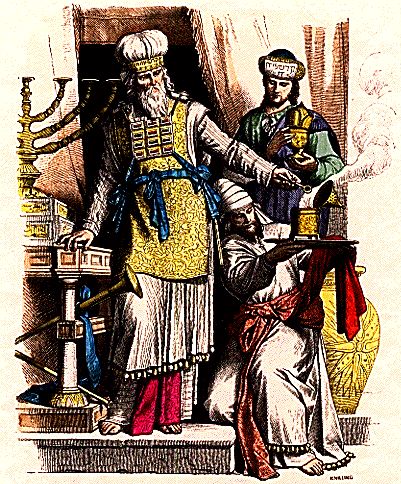
4And these are the garments which they shall make; a breastplate, and an ephod, and a robe, and a broidered coat, a mitre, and a girdle: and they shall make holy garments for Aaron thy brother, and his sons, that he may minister unto me in the priest's office.
The image to the right is from The History of Costume, by Braun & Schneider, 1861-1880. It's a jewish high priest wearing the outfit.
9And thou shalt take two onyx stones, and grave on them the names of the children of Israel:
Nobody is exactly sure the order of the names.
15And thou shalt make the breastplate of judgment with cunning work; after the work of the ephod thou shalt make it; of gold, of blue, and of purple, and of scarlet, and of fine twined linen, shalt thou make it.
Cunning work. It had better be cunning!
17And thou shalt set in it settings of stones, even four rows of stones: the first row shall be a sardius, a topaz, and a carbuncle: this shall be the first row.
18And the second row shall be an emerald, a sapphire, and a diamond.
19And the third row a ligure, an agate, and an amethyst.
20And the fourth row a beryl, and an onyx, and a jasper: they shall be set in gold in their inclosings.
Each stone represented one of the tribes/children of Israel.Sardius is Carnelian, a reddish brown mineral, that is a semi-precious gemstone.
Topaz is a mineral of aluminum and flourine. It comes in several colors, from colorless to orange, to yellow, pink, pale green, blue, gold and other colors.
Carbuncle is an abscess larger than a boil, it is caused by a bacterial infection, it is filled with fluid, puss and dead tissue... oh wait, this carbuncle is a red cabachon cut gemstone, probably a red garnet.
Emerald is green.
Sapphires are normally blue.
Diamonds are... diamonds.
Ligures are possibly amber. No one is really sure what it is.
Agates are semi-precious, they are a style of quartz. The one used here was probably sky blue.
Amethysts are purple minerals. Supposely amethysts protect people from getting drunk. The name means not intoxicating. That gives new meaning to the Amethyst Initiative.
Beryl, there are several varieties, aquamarine, red, emerald, golden, colorless, and pink. This was probably a white beryl.
Onyx is normally black, at least we think of black onyx most. It can be most any color. It is also a type of quarts, like agate.
Jasper is a spotted or speckled stone, and that's what the name means. It can come in several colors, red, yellow, brown, green, and rarely blue.
No one is exactly sure what most of the gems are. No one is sure what the breastplate actually looked like. No one is sure who was represented by what gem. Most of the precious stones were uncut. Diamond cutting didn't begin until after the 1200's AD. Additionally, they wouldn't have had the ability to cut diamonds. The other harder stones would just be stones as well. The pretty pictures that you see as representations of the Hoshen (breastplate) are idealized artists renderings. If it has cut stones, then it's not even possible that that's what it looked like.
21And the stones shall be with the names of the children of Israel, twelve, according to their names, like the engravings of a signet; every one with his name shall they be according to the twelve tribes.
Additionally, you are to believe that a diamond was engraved.
30And thou shalt put in the breastplate of judgment the Urim and the Thummim; and they shall be upon Aaron's heart, when he goeth in before the LORD: and Aaron shall bear the judgment of the children of Israel upon his heart before the LORD continually.
Urim and Thummim. What are they, why do they get capitalized? Again, no one is exactly sure what they were, let alone what they were made of. These two objects were used for divination. They were placed in a bag, and whichever one was pulled determined the outcome. Thummim was the innocent stone while Urim was the cursed stone. Urim for guilty, Thummim for innocent. You'll note the order, implying the person was guilty until proven innocent. Except that they weren't proven, they were picked, with a 50-50 chance.
Aaron also got some more clothes to wear, as did his children.
Exodus 29
1And this is the thing that thou shalt do unto them to hallow them, to minister unto me in the priest's office: Take one young bullock, and two rams without blemish,
Oddly, Aaron and his boys don't minister to the congregation, they minister to god.
2And unleavened bread, and cakes unleavened tempered with oil, and wafers unleavened anointed with oil: of wheaten flour shalt thou make them.
Unleavened, because god hates yeast.
Then Aaron and his boys get dressed up in the Exodus 28 outfits. They put their hands on the head of the bullock...
11And thou shalt kill the bullock before the LORD, by the door of the tabernacle of the congregation.
12And thou shalt take of the blood of the bullock, and put it upon the horns of the altar with thy finger, and pour all the blood beside the bottom of the altar.
And kill it.Then they burn the guts on the altar. They burn the skin and poop outside camp.
15Thou shalt also take one ram; and Aaron and his sons shall put their hands upon the head of the ram.
16And thou shalt slay the ram, and thou shalt take his blood, and sprinkle it round about upon the altar.
The first ram is cut up, and burned on the altar.20Then shalt thou kill the ram, and take of his blood, and put it upon the tip of the right ear of Aaron, and upon the tip of the right ear of his sons, and upon the thumb of their right hand, and upon the great toe of their right foot, and sprinkle the blood upon the altar round about.
Then there's a bizarre ritual with putting blood on everyone.
21And thou shalt take of the blood that is upon the altar, and of the anointing oil, and sprinkle it upon Aaron, and upon his garments, and upon his sons, and upon the garments of his sons with him: and he shall be hallowed, and his garments, and his sons, and his sons' garments with him.
And with that, they are washed in the blood of the ram. They are now able to minister to god.
But what do you do with all that meat? Well, god doesn't eat it, so Aaron and his sons have to.
28And it shall be Aaron's and his sons' by a statute for ever from the children of Israel: for it is an heave offering: and it shall be an heave offering from the children of Israel of the sacrifice of their peace offerings, even their heave offering unto the LORD.
29And the holy garments of Aaron shall be his sons' after him, to be anointed therein, and to be consecrated in them.
From the exodus to ... um... forever, the animals sacrificed wind up being eaten by Aaron and his sons. Which isn't a bad job to be born into.32And Aaron and his sons shall eat the flesh of the ram, and the bread that is in the basket by the door of the tabernacle of the congregation.
33And they shall eat those things wherewith the atonement was made, to consecrate and to sanctify them: but a stranger shall not eat thereof, because they are holy.
In fact, the food can't be feed to anyone else, it's only for the priests.38Now this is that which thou shalt offer upon the altar; two lambs of the first year day by day continually.
39The one lamb thou shalt offer in the morning; and the other lamb thou shalt offer at even:
Every day, Aaron and his sons have to kill animals and eat them. A lamb in the morning and a lamb at night.44And I will sanctify the tabernacle of the congregation, and the altar: I will sanctify also both Aaron and his sons, to minister to me in the priest's office.
Why Moses didn't protect his children from ever having to get a real job is beyond me. Why he set up Aaron and his boys for eternity was a nice thing to do for his brother.
Exodus 30
1And thou shalt make an altar to burn incense upon: of shittim wood shalt thou make it.
Now the tabernacle is going to be a restaurant that only serves Aaron's sons, but also, there's going to be incense being burned. So it may not be the best smelling place. Although the incense will probably cover up the smell of all the blood that's spilled everywhere.
13This they shall give, every one that passeth among them that are numbered, half a shekel after the shekel of the sanctuary: (a shekel is twenty gerahs:) an half shekel shall be the offering of the LORD.
So, not only do the Kohanim never have to work to get food, now they also get a half a shekel from everyone.
14Every one that passeth among them that are numbered, from twenty years old and above, shall give an offering unto the LORD.
Remember, there were 600,000 people who left (Exodus 12:37).
15The rich shall not give more, and the poor shall not give less than half a shekel, when they give an offering unto the LORD, to make an atonement for your souls.
God costs the same regardless of your worth.
25And thou shalt make it an oil of holy ointment, an ointment compound after the art of the apothecary: it shall be an holy anointing oil.
This is the ingredients in the anointing oil: myrrh, sweet cinnamon, sweet calamus, cassia, and olive oil. Sounds good enough.
Myrrh is one of the gifts of the three wise men. It's the dried sap of a tree. It provides an earthy smell.
Sweet cinnamon is cinnamon.
Cassia is is a relative of cinnamon.
Olive oil is olive oil. So what have we left out...
Sweet Calamus is also known as Sweet Flag. It's a tall perennial wetland monocot with scented leaves and more strongly scented rhizomes, which have been used medicinally, for its odor, and as a psychotropic drug. Wait... what??? A psychotropic drug? Currently, calamus is banned in the US because it's a drug. In high doses, it is a hallucinogenic. Why did Moses, Aaron, and his boys see god? They were tripping.
30And thou shalt anoint Aaron and his sons, and consecrate them, that they may minister unto me in the priest's office.
So after the boys are anointed in the drugged oil, they now can go minister to god.
32Upon man's flesh shall it not be poured, neither shall ye make any other like it, after the composition of it: it is holy, and it shall be holy unto you.
It's not only holy, it's a controlled substance.
God then tells Moses to make his favorite perfume. It needed to have stacte, onycha, and galbanum, along with pure frankincense. (Frankincense was one of the other things the wise men brought).
No one knows what stacte was. It's believed to be high quality myrrh. Onycha is apparently crushed up sea snail shells. Galbanum is the gum resin of the plant Ferula Gummosa.
38Whosoever shall make like unto that, to smell thereto, shall even be cut off from his people.
Anyone who makes god's own perfume will be kicked out.
Points to ponder:
1. You'd think after all these years, that the Jewish people would give up on honoring Moses wishes. Especially the part about his brothers kids never having to do any real work.
2. What do you think the priests robes looked like?
3. Do you believe that the diamond was actually cut with someone's name on it?
4. Today, leaders of religions who use drugs normally wind up either in jail, or having killed their entire flock; it's a good thing that Moses didn't lead his people to Jonestown, otherwise we wouldn't have the great moral code that the bible is.

