Thursday, February 4, 2010

Day 31. Leviticus 4-6

Leviticus 4-6

Leviticus 4

2Speak unto the children of Israel, saying, If a soul shall sin through ignorance against any of the commandments of the LORD concerning things which ought not to be done, and shall do against any of them:

These are the punishments for ignorant sins.


3If the priest that is anointed do sin according to the sin of the people; then let him bring for his sin, which he hath sinned, a young bullock without blemish unto the LORD for a sin offering.

4And he shall bring the bullock unto the door of the tabernacle of the congregation before the LORD; and shall lay his hand upon the bullock's head, and kill the bullock before the LORD.

A sin of ignorance. Not knowing the law is no reason for not atoning for it. A priest sins, the price is a bullock (cow).

6And the priest shall dip his finger in the blood, and sprinkle of the blood seven times before the LORD, before the vail of the sanctuary.

The bible isn't just full of laws, there's bizarre rituals too!

7And the priest shall put some of the blood upon the horns of the altar of sweet incense before the LORD, which is in the tabernacle of the congregation; and shall pour all the blood of the bullock at the bottom of the altar of the burnt offering, which is at the door of the tabernacle of the congregation.

The people aren't to eat blood, blood is for god.

13And if the whole congregation of Israel sin through ignorance, and the thing be hid from the eyes of the assembly, and they have done somewhat against any of the commandments of the LORD concerning things which should not be done, and are guilty;

How can an entire society sin through ignorance?

14When the sin, which they have sinned against it, is known, then the congregation shall offer a young bullock for the sin, and bring him before the tabernacle of the congregation.

The price for one priest is the same price as for a multitude.

17And the priest shall dip his finger in some of the blood, and sprinkle it seven times before the LORD, even before the vail.

People always claim that satanist are out in the woods sacrificing cows to satan. Maybe they are just Hebrews following levitical law?

22When a ruler hath sinned, and done somewhat through ignorance against any of the commandments of the LORD his God concerning things which should not be done, and is guilty;

23Or if his sin, wherein he hath sinned, come to his knowledge; he shall bring his offering, a kid of the goats, a male without blemish:

The leader must offer a male goat.

27And if any one of the common people sin through ignorance, while he doeth somewhat against any of the commandments of the LORD concerning things which ought not to be done, and be guilty;

28Or if his sin, which he hath sinned, come to his knowledge: then he shall bring his offering, a kid of the goats, a female without blemish, for his sin which he hath sinned.

A commoner must offer a female goat.

32And if he bring a lamb for a sin offering, he shall bring it a female without blemish.

Or a female sheep.

Leviticus 5

1And if a soul sin, and hear the voice of swearing, and is a witness, whether he hath seen or known of it; if he do not utter it, then he shall bear his iniquity.

This chapter will have a lot of leviticacisms. These are laws that the people have to follow. There are actually 613 laws. These are the 613 Mitzvot. Most are found in Deuteronomy and Numbers, but some are here in Leviticus.

2Or if a soul touch any unclean thing, whether it be a carcase of an unclean beast, or a carcase of unclean cattle, or the carcase of unclean creeping things, and if it be hidden from him; he also shall be unclean, and guilty.

Don't touch dead things.

These first few verses in chapter 5 are trespasses. Touching dead things is as bad as swearing which is as bad as making an oath to do bad things to someone.

6And he shall bring his trespass offering unto the LORD for his sin which he hath sinned, a female from the flock, a lamb or a kid of the goats, for a sin offering; and the priest shall make an atonement for him concerning his sin.

7And if he be not able to bring a lamb, then he shall bring for his trespass, which he hath committed, two turtledoves, or two young pigeons, unto the LORD; one for a sin offering, and the other for a burnt offering.

A female sheep, or goat or two pigeons is the punishment.

11But if he be not able to bring two turtledoves, or two young pigeons, then he that sinned shall bring for his offering the tenth part of an ephah of fine flour for a sin offering; he shall put no oil upon it, neither shall he put any frankincense thereon: for it is a sin offering.

You could also bring flour.

I find it odd that the people are able to make offerings of flour when they are currently out gathering manna each day.

17And if a soul sin, and commit any of these things which are forbidden to be done by the commandments of the LORD; though he wist it not, yet is he guilty, and shall bear his iniquity.

Even though you don't know you are breaking the law, you still have to pay. The punishment is a ram.

Leviticus 6

2If a soul sin, and commit a trespass against the LORD, and lie unto his neighbour in that which was delivered him to keep, or in fellowship, or in a thing taken away by violence, or hath deceived his neighbour;

If you lose something, or break something that you borrowed or were keeping for your neighbor, you have to restore it, along with 20% interest.

6And he shall bring his trespass offering unto the LORD, a ram without blemish out of the flock, with thy estimation, for a trespass offering, unto the priest:

And... a ram.

9Command Aaron and his sons, saying, This is the law of the burnt offering: It is the burnt offering, because of the burning upon the altar all night unto the morning, and the fire of the altar shall be burning in it.

10And the priest shall put on his linen garment, and his linen breeches shall he put upon his flesh, and take up the ashes which the fire hath consumed with the burnt offering on the altar, and he shall put them beside the altar.

11And he shall put off his garments, and put on other garments, and carry forth the ashes without the camp unto a clean place.

The priest doesn't just get to spend all day killing animals and eating them, he also has to dump the ashes outside the camp.

Odd, that they would have a camp law. When the rest of the laws seem to imply that the people are raising grains for flour, and tending other animals.

13The fire shall ever be burning upon the altar; it shall never go out.

Yes, that law is still in full effect.

14And this is the law of the meat offering: the sons of Aaron shall offer it before the LORD, before the altar.

15And he shall take of it his handful, of the flour of the meat offering, and of the oil thereof, and all the frankincense which is upon the meat offering, and shall burn it upon the altar for a sweet savour, even the memorial of it, unto the LORD.

16And the remainder thereof shall Aaron and his sons eat: with unleavened bread shall it be eaten in the holy place; in the court of the tabernacle of the congregation they shall eat it.

That's great, a handful of the flour will be burned, the rest is to be eaten by Aaron and his sons. Why is the offering so much more than is required? To feed Aaron.

18All the males among the children of Aaron shall eat of it. It shall be a statute for ever in your generations concerning the offerings of the LORD made by fire: every one that toucheth them shall be holy.

Only the sons of Aaron get to eat it.

25Speak unto Aaron and to his sons, saying, This is the law of the sin offering: In the place where the burnt offering is killed shall the sin offering be killed before the LORD: it is most holy.

All the meat gets to be eaten by the priests.

But not the blood.

30And no sin offering, whereof any of the blood is brought into the tabernacle of the congregation to reconcile withal in the holy place, shall be eaten: it shall be burnt in the fire.

The people aren't to eat (drink) blood. That's another one of those interesting things about Jesus, why would he say to drink his blood, when people aren't allowed to eat/drink any blood.

Points to ponder:

1. Ignorance of the law doesn't give you a pass, it just changes the thing you have to offer to atone.

2. Priests sins are as grievous as if everyone in the community had sinned.

3. I wish my dad founded a religion that meant that I'd never have to do any work except prepare my meals all day long.

Day 30. Leviticus 1-3

Leviticus 1-3

Leviticus 1

1And the LORD called unto Moses, and spake unto him out of the tabernacle of the congregation, saying,

Ah, Leviticus. One of my favorite books. This is another of the books of Moses. Leviticus contains a lot of laws, mostly that deal with the Levites. Remember, Moses set up his brother and his nephews with being the main chief priests for all time. But he didn't just stop there, no. He also created a position of honor for the rest of his tribe. This book deals mostly with them and rules for them. There will be a lot of abominations. I'll try to highlight them all.

Chapter one tells the priests how they are to prepare the animals that are offerings.

First is the bullock.

5And he shall kill the bullock before the LORD: and the priests, Aaron's sons, shall bring the blood, and sprinkle the blood round about upon the altar that is by the door of the tabernacle of the congregation.

If people actually sacrificed as many animals as is mentioned, these people would be master butchers.

9But his inwards and his legs shall he wash in water: and the priest shall burn all on the altar, to be a burnt sacrifice, an offering made by fire, of a sweet savour unto the LORD.

The front part is cooked, the back part is burned. Kosher and non-kosher. Exactly why the back isn't Kosher, I'm not sure. Some websites say it's because of the sciatic nerve and because of blood vessels.

The next sacrificial animal is sheep. Again, can't eat the legs.

The final offering animal is turtledoves or pigeons.

15And the priest shall bring it unto the altar, and wring off his head, and burn it on the altar; and the blood thereof shall be wrung out at the side of the altar:

Wringing is much more human than other methods of head removal of doves.

Leviticus 2

1And when any will offer a meat offering unto the LORD, his offering shall be of fine flour; and he shall pour oil upon it, and put frankincense thereon:

Meat, again, means food other than what we call meat.

2And he shall bring it to Aaron's sons the priests: and he shall take thereout his handful of the flour thereof, and of the oil thereof, with all the frankincense thereof; and the priest shall burn the memorial of it upon the altar, to be an offering made by fire, of a sweet savour unto the LORD:

Basically, the priest gets to make a piece of flat bread.

There are several types of "meat" offerings: flour, baked in an oven, baked in a pan, and baked in a frying pan.

9And the priest shall take from the meat offering a memorial thereof, and shall burn it upon the altar: it is an offering made by fire, of a sweet savour unto the LORD.

The first part goes to god.

10And that which is left of the meat offering shall be Aaron's and his sons': it is a thing most holy of the offerings of the LORD made by fire.

Someone's got to finish off the bread, should we give it to the homeless? No, let's give it to the priests.

12As for the oblation of the firstfruits, ye shall offer them unto the LORD: but they shall not be burnt on the altar for a sweet savour.

The priests get to have a well balanced diet. Animal flesh, flat breads, and now fruits.

13And every oblation of thy meat offering shalt thou season with salt; neither shalt thou suffer the salt of the covenant of thy God to be lacking from thy meat offering: with all thine offerings thou shalt offer salt.

God likes salt. Additionally, how hard would it be for people in the desert to get salt? Not only do they have to give up their animals and flour and fruit, now they have to give up some of their main preservative. It's not like the priests needed to store any of their food, they were continually offering sacrifices. It was the average people who were giving up their things.

Leviticus 3

1And if his oblation be a sacrifice of peace offering, if he offer it of the herd; whether it be a male or female, he shall offer it without blemish before the LORD.

No one is entirely sure the reason behind the sacrifice of peace offering. It's probably given because the person has been blessed, and wants to give back.

17It shall be a perpetual statute for your generations throughout all your dwellings, that ye eat neither fat nor blood.

That verse is a good... um... leviticacism. There's all these rules about what priests have to do to prepare offerings, and then BAM, a rule that affects the common Joe. I was reading about priests, and now I learn that we shouldn't eat fat or blood.

Points to ponder:

1. Priests probably couldn't be vegetarians. Part of their job was consuming all this flesh.

2. How many people could have been fed by the rear part of the cows that were ritually sacrificed over the years?

3. There is no law against selling the un-kosher parts of the animal to people who aren't Hebrew.

Day 29. Exodus 37-40

Exodus 37-40

Exodus 37

1And Bezaleel made the ark of shittim wood: two cubits and a half was the length of it, and a cubit and a half the breadth of it, and a cubit and a half the height of it:

I still wonder how a guy who spent his days making bricks and building a store cities for an unnamed pharaoh was able to make what was supposed to be one of the most beautiful things ever created.

First he made the ark.

10And he made the table of shittim wood: two cubits was the length thereof, and a cubit the breadth thereof, and a cubit and a half the height thereof:

Then he made the table.

16And he made the vessels which were upon the table, his dishes, and his spoons, and his bowls, and his covers to cover withal, of pure gold.

And the things for the table.

17And he made the candlestick of pure gold: of beaten work made he the candlestick; his shaft, and his branch, his bowls, his knops, and his flowers, were of the same:

Then he made the candlestick.

25And he made the incense altar of shittim wood: the length of it was a cubit, and the breadth of it a cubit; it was foursquare; and two cubits was the height of it; the horns thereof were of the same.

Then he made the altar.

29And he made the holy anointing oil, and the pure incense of sweet spices, according to the work of the apothecary.

Finally, the guy who was extremely great at making tables and arks and doing other work with gold, was also a great enough guy, to make the hallucinogenic oil.

Exodus 38

1And he made the altar of burnt offering of shittim wood: five cubits was the length thereof, and five cubits the breadth thereof; it was foursquare; and three cubits the height thereof.

2And he made the horns thereof on the four corners of it; the horns thereof were of the same: and he overlaid it with brass.

After making the fancy gold things, he set about to make the brass things.

10Their pillars were twenty, and their brasen sockets twenty; the hooks of the pillars and their fillets were of silver.

He also did some silver work.

16All the hangings of the court round about were of fine twined linen.

There wasn't anyone else who was with them in the desert who could have done anything? We are to believe that this guy is a carpenter, goldsmith, silversmith, brass-smith, and now he's also good with fabrics.

18And the hanging for the gate of the court was needlework, of blue, and purple, and scarlet, and fine twined linen: and twenty cubits was the length, and the height in the breadth was five cubits, answerable to the hangings of the court.

He does needlework too.

Apparently there were some other people with him.

22And Bezaleel the son Uri, the son of Hur, of the tribe of Judah, made all that the LORD commanded Moses.

23And with him was Aholiab, son of Ahisamach, of the tribe of Dan, an engraver, and a cunning workman, and an embroiderer in blue, and in purple, and in scarlet, and fine linen.

Well, just Bezaleel and Aholiab. They did it all.

Next we get the weight/volume of the gold, silver, and brass that were used to make the tabernacle.

26A bekah for every man, that is, half a shekel, after the shekel of the sanctuary, for every one that went to be numbered, from twenty years old and upward, for six hundred thousand and three thousand and five hundred and fifty men.

Modern christianity seems very caught up in capitalism. Modern christians tend to be right wing republican. They are very anti-socialism. Most of the tea-party people are conservative. (I believe they just don't want to pay to help other people, but they'll claim they are against socialism). One second they will praise the free market, then on Sunday, they'll praise Jesus. They'll claim they believe and follow the whole bible, not just pick and choose the verses they like, even though it's obvious they don't. Verse 26 says that everyone who was numbered paid the same for building the sanctuary. If everyone pays for something for the common good (or bad) of the community, that's socialism. God is a socialist.

Exodus 39

1And of the blue, and purple, and scarlet, they made cloths of service, to do service in the holy place, and made the holy garments for Aaron; as the LORD commanded Moses.

They can also make clothes.

14And the stones were according to the names of the children of Israel, twelve, according to their names, like the engravings of a signet, every one with his name, according to the twelve tribes.

They are jewelers.

27And they made coats of fine linen of woven work for Aaron, and for his sons,

The Hebrews were in a hurry to leave Egypt and didn't have time to let their bread rise, but they did have time to take yards of fine linen.

32Thus was all the work of the tabernacle of the tent of the congregation finished: and the children of Israel did according to all that the LORD commanded Moses, so did they.

The two guys, who if we believe the story of captivity that they were city building slaves, were able to produce all of these things.

43And Moses did look upon all the work, and, behold, they had done it as the LORD had commanded, even so had they done it: and Moses blessed them.

Moses really like it. Good for Moses.

Exodus 40

God tells Moses:

2On the first day of the first month shalt thou set up the tabernacle of the tent of the congregation.

God then gives instructions of what needs to be done, including washing Aaron and his sons.

17And it came to pass in the first month in the second year, on the first day of the month, that the tabernacle was reared up.

Ohhh, another date.

18And Moses reared up the tabernacle, and fastened his sockets, and set up the boards thereof, and put in the bars thereof, and reared up his pillars.

Apparently the tabernacle was able to be set up by one man. Moses finally got everything set up correctly.

34Then a cloud covered the tent of the congregation, and the glory of the LORD filled the tabernacle.

Or, Moses was just really stoned.

35And Moses was not able to enter into the tent of the congregation, because the cloud abode thereon, and the glory of the LORD filled the tabernacle.

But Moses talked to god face to face in the tabernacle before. (Exodus 33:7,11)

Then God showed the people what days they would walk, by his cloud. If the cloud was on the tabernacle, they didn't go anywhere, if it moved, they had to pack up and follow him.

Thus ends Exodus.

Points to ponder:

1. Did two people build all those things?

2. Is it possible for two people to build those things while traveling around in the desert, seemingly without all their tools?

3. Moses has set up a society, where his family is taken care of for eternity.

Friday, January 29, 2010

Day 28. Exodus 34-36

Exodus 34-36

Exodus 34

1And the LORD said unto Moses, Hew thee two tables of stone like unto the first: and I will write upon these tables the words that were in the first tables, which thou brakest.

Moses had to carve out the stone tablets, but god was doing the writing.

God comes down to the mountiain, to see moses.

6And the LORD passed by before him, and proclaimed, The LORD, The LORD God, merciful and gracious, longsuffering, and abundant in goodness and truth,

7Keeping mercy for thousands, forgiving iniquity and transgression and sin, and that will by no means clear the guilty; visiting the iniquity of the fathers upon the children, and upon the children's children, unto the third and to the fourth generation.

That has got to be one of the best entrances ever! You think Shawn Michaels arrived like that? You think Triple H, arrived like that? God sounds like Bret Hart, the best there is, the best there was, the best there ever will be.

His entrance also makes very little sense. If he's forgiving iniquity, then why is he then visiting it upon the children? Is it just of anyone to punish children for the acts of their parents?

God then tells Moses that he's going to drive out the inhabitants of Canaan, and that they are to not make a peace treaty with them.

12Take heed to thyself, lest thou make a covenant with the inhabitants of the land whither thou goest, lest it be for a snare in the midst of thee:

13But ye shall destroy their altars, break their images, and cut down their groves:

14For thou shalt worship no other god: for the LORD, whose name is Jealous, is a jealous God:

Exodus 34:14 says god is jealous. This verse coupled with 1 Corinthians 13:4 and 1 John 4:8 are one of the main parts that KJV-only people will cling to. Here, we see, god is jealous; in 1 john, god is love; in corinthians, it says charity doesn't envy. (All 3 verses here, in KJV)

Let us look at those verses in the NIV (New International Version).

Exodus makes god jealous, great.
John makes god love, awesome.
Corinthians talks about love, and says that love doesn't envy. Envy is jealousy. There is a contradiction, something isn't right. Either he is or he isn't.

People will go to many lengths to not have the bible be wrong. KJV-only people will claim that the NIV is wrong due to that. You can't have god be contradicted.

Back to today's reading.

16And thou take of their daughters unto thy sons, and their daughters go a whoring after their gods, and make thy sons go a whoring after their gods.

God wants them to not marry the inhabitants so that the people don't go following other gods. It's safer to commit genocide than to risk having the people possibly follow a different god.

17Thou shalt make thee no molten gods.

Hey, this sounds familiar... This is the stuff on the tablets. What are we up to? Number 2?

1. Thou shalt not worship no other god. (verse 14)

2. Thou shalt make thee no molten gods. (verse 17)

18The feast of unleavened bread shalt thou keep. Seven days thou shalt eat unleavened bread, as I commanded thee, in the time of the month Abib: for in the month Abib thou camest out from Egypt.

3. The feast of unleavened bread shalt thou keep. (verse 18)
19All that openeth the matrix is mine; and every firstling among thy cattle, whether ox or sheep, that is male.

4. All firstborn are mine. (verse 19)

21Six days thou shalt work, but on the seventh day thou shalt rest: in earing time and in harvest thou shalt rest.

5. Six days shalt thou work, but on the seventh thou shalt rest. (verse 21)

22And thou shalt observe the feast of weeks, of the firstfruits of wheat harvest, and the feast of ingathering at the year's end.

6. Thou shalt observe the feast of weeks, even of the first fruits of the wheat harvest, and the feast of ingathering at the years end. (verse 22)

25Thou shalt not offer the blood of my sacrifice with leaven; neither shall the sacrifice of the feast of the passover be left unto the morning.

7. Thou shalt not offer the blood of my sacrifice with leavened bread. (verse 25)

8. The fat of my feast shall not remain all night until the morning. (verse 25)
26The first of the firstfruits of thy land thou shalt bring unto the house of the LORD thy God. Thou shalt not seethe a kid in his mother's milk.

9. The first of the first fruits of thy ground thou shalt bring unto the house of the Lord thy God. (verse 26)

10. Thou shalt not seethe a kid in its mother's milk. (verse 26)

28And he was there with the LORD forty days and forty nights; he did neither eat bread, nor drink water. And he wrote upon the tables the words of the covenant, the ten commandments.

Boom, those are the ten commandments. There is no thou shalt not kill. There is nothing like that. The ten commandments that are written on stone, the tablets of testimony include "thou shalt not seethe a kid in its mother's milk", not "thou shalt not kill".

29And it came to pass, when Moses came down from mount Sinai with the two tables of testimony in Moses' hand, when he came down from the mount, that Moses wist not that the skin of his face shone while he talked with him.

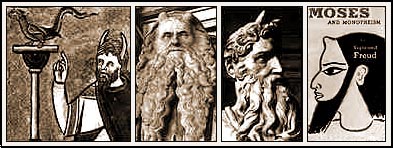
This verse means one of a couple of things, he was either radiant. Or Moses grew horns.


During the Renaissance, Moses was often depicted with horns, the most famous is probably the third picture above, done by Michelangelo.

35And the children of Israel saw the face of Moses, that the skin of Moses' face shone: and Moses put the vail upon his face again, until he went in to speak with him.

So, horny Moses wore a veil.

Exodus 35

1And Moses gathered all the congregation of the children of Israel together, and said unto them, These are the words which the LORD hath commanded, that ye should do them.

Oddly, he only told them about the sabbath. Oh, and the punishment is death.

Then he asked for the items to build things. So at this point, the tabernacle hasn't been built yet. Even though in Exodus 33:8, Moses went into the tabernacle.

21And they came, every one whose heart stirred him up, and every one whom his spirit made willing, and they brought the LORD's offering to the work of the tabernacle of the congregation, and for all his service, and for the holy garments.

Oddly, people roaming around in the wilderness had enough things that they "borrowed" from Egypt to build the tabernacle.

Then Moses calls out Bezaleel, and Aholiab to do the work.

Exodus 36

1Then wrought Bezaleel and Aholiab, and every wise hearted man, in whom the LORD put wisdom and understanding to know how to work all manner of work for the service of the sanctuary, according to all that the LORD had commanded.

Moses gives them the offering.

5And they spake unto Moses, saying, The people bring much more than enough for the service of the work, which the LORD commanded to make.

Moses then told the people to stop giving. Does this still happen. When you are given a command to build something to exact specifications, but wind up with more money than you need, do you stop asking for money, or do you try to provide something BETTER than what was asked?

The rest of the chapter is about them making the things to the same specifications as were mentioned earlier.

Points to ponder:

1. Did Moses have horns? Him not having horns is a newer concept than him having them.

2. What do you think the ten commandments held in the ark were? Was it the "Thou shalt not kill" set, or the "seethe a kid" version?

3. Does god visit iniquity on the kids, or does he let them make their own mistakes?

4. Is genocide an option?

Thursday, January 28, 2010

Day 27. Exodus 31-33

Exodus 31-33

Exodus 31

God talks to Moses:

2See, I have called by name Bezaleel the son of Uri, the son of Hur, of the tribe of Judah:

Bezaleel is the master smith. He's good in gold, silver and brass. Which makes you wonder how he got to be that way, when we're just led to believe that the only thing the Hebrews did while they were in Egypt was make bricks.

6And I, behold, I have given with him Aholiab, the son of Ahisamach, of the tribe of Dan: and in the hearts of all that are wise hearted I have put wisdom, that they may make all that I have commanded thee;

Aholiab is going to be Bezaleel's assistant. Together, they will make the tabernacle, the ark, the furniture, the candlestick and the garments.

God continues... sort of rambling...

13Speak thou also unto the children of Israel, saying, Verily my sabbaths ye shall keep: for it is a sign between me and you throughout your generations; that ye may know that I am the LORD that doth sanctify you.

14Ye shall keep the sabbath therefore; for it is holy unto you: every one that defileth it shall surely be put to death: for whosoever doeth any work therein, that soul shall be cut off from among his people.

Then he gives Moses the testimony.

18And he gave unto Moses, when he had made an end of communing with him upon mount Sinai, two tables of testimony, tables of stone, written with the finger of God.

Written with the finger of God.

Exodus 32

1And when the people saw that Moses delayed to come down out of the mount, the people gathered themselves together unto Aaron, and said unto him, Up, make us gods, which shall go before us; for as for this Moses, the man that brought us up out of the land of Egypt, we wot not what is become of him.

Moses is gone for 40 days, the people think he's dead, so they demand something to worship.

2And Aaron said unto them, Break off the golden earrings, which are in the ears of your wives, of your sons, and of your daughters, and bring them unto me.

So, the people had earrings. The people hadn't started the creation of the tabernacle and the rest of the stuff yet, so they still had some gold available.

4And he received them at their hand, and fashioned it with a graving tool, after he had made it a molten calf: and they said, These be thy gods, O Israel, which brought thee up out of the land of Egypt.

Aaron was apparently skilled enough to make a golden calf.

Aaron them makes the next day a feast day. Aaron must be a master engraver. It only took him about a day to do it. Remember, according to Exodus 24:18 Moses was on the mount for 40 days and nights. So on the 39th day, Aaron completed the building of the calf. On the 40th day, was to be the feast.

7And the LORD said unto Moses, Go, get thee down; for thy people, which thou broughtest out of the land of Egypt, have corrupted themselves:

They corrupted themselves. It's not the fault of the god who was talking with only one person giving his law, it's the fault of the people who had time to themselves.

8They have turned aside quickly out of the way which I commanded them: they have made them a molten calf, and have worshipped it, and have sacrificed thereunto, and said, These be thy gods, O Israel, which have brought thee up out of the land of Egypt.

It only took thirty some days for them to realize they wanted a new god.

10Now therefore let me alone, that my wrath may wax hot against them, and that I may consume them: and I will make of thee a great nation.

God tells Moses that he will kill all the Hebrews and he will make him, MOSES, be the father of the people. Instead of being Israel, it will be Moses.

Moses intercedes. There are two great intercessions, they were by Moses and Samuel. There was one intercession that would fail, so god didn't let it happen, and that was by Jeremiah.

Moses basically tells god that he didn't bring the people out of Egypt to kill them in the wilderness.

14And the LORD repented of the evil which he thought to do unto his people.

God wanted to do evil. God repented. Who does god repent to?

15And Moses turned, and went down from the mount, and the two tables of the testimony were in his hand: the tables were written on both their sides; on the one side and on the other were they written.

16And the tables were the work of God, and the writing was the writing of God, graven upon the tables.

There is a lot of mythology regarding the tablets. That the lettering was the same on both sides. That it wasn't sentences, but only one letter, representing each of the laws.

19And it came to pass, as soon as he came nigh unto the camp, that he saw the calf, and the dancing: and Moses' anger waxed hot, and he cast the tables out of his hands, and brake them beneath the mount.

Moses comes down, and breaks the first set of commandments.

20And he took the calf which they had made, and burnt it in the fire, and ground it to powder, and strawed it upon the water, and made the children of Israel drink of it.

Moses made goldschlager.

Aaron then says it wasn't his fault.

26Then Moses stood in the gate of the camp, and said, Who is on the LORD's side? let him come unto me. And all the sons of Levi gathered themselves together unto him.

Remember, the boy Levi and his brother Simeon were the ones who killed everyone in the city of Shechem, back in Genesis 34.

27And he said unto them, Thus saith the LORD God of Israel, Put every man his sword by his side, and go in and out from gate to gate throughout the camp, and slay every man his brother, and every man his companion, and every man his neighbour.

28And the children of Levi did according to the word of Moses: and there fell of the people that day about three thousand men.


God wanted to kill the people, Moses said no, don't do it... I'll do it.

31And Moses returned unto the LORD, and said, Oh, this people have sinned a great sin, and have made them gods of gold.

32Yet now, if thou wilt forgive their sin--; and if not, blot me, I pray thee, out of thy book which thou hast written.

Moses is kind of emo... take me, not them.

35And the LORD plagued the people, because they made the calf, which Aaron made.

Funny verse, because they made the calf, which Aaron made. Aaron winds up coming out relatively blameless in the whole ordeal.

Exodus 33

1And the LORD said unto Moses, Depart, and go up hence, thou and the people which thou hast brought up out of the land of Egypt, unto the land which I sware unto Abraham, to Isaac, and to Jacob, saying, Unto thy seed will I give it:

The Land of Milk and Honey.

2And I will send an angel before thee; and I will drive out the Canaanite, the Amorite, and the Hittite, and the Perizzite, the Hivite, and the Jebusite:

The people are promised that the current inhabitants will be evacuated.

7And Moses took the tabernacle, and pitched it without the camp, afar off from the camp, and called it the Tabernacle of the congregation. And it came to pass, that every one which sought the LORD went out unto the tabernacle of the congregation, which was without the camp.

So the tabernacle had already been created. That's weird. The mercy seat was where Moses and Aaron were to minister to the lord. Why did Moses have to go to the mount?

9And it came to pass, as Moses entered into the tabernacle, the cloudy pillar descended, and stood at the door of the tabernacle, and the Lord talked with Moses.

Moses put on a show, whenever he'd go talk to the lord, there would be a cloudy pillar that descended. Or, he was so doped up on the anointing oil, that he just assumed that it happened.

11And the LORD spake unto Moses face to face, as a man speaketh unto his friend. And he turned again into the camp: but his servant Joshua, the son of Nun, a young man, departed not out of the tabernacle.

Here, Moses talks to god face to face. Remember this...

20And he said, Thou canst not see my face: for there shall no man see me, and live.

Really? Seriously? You just said they spoke face to face, and now you claim you can't see his face?

22And it shall come to pass, while my glory passeth by, that I will put thee in a clift of the rock, and will cover thee with my hand while I pass by:

23And I will take away mine hand, and thou shalt see my back parts: but my face shall not be seen.

You can't see god's face, but you can see the holy hiney!

Points to ponder:

1. Why did Aaron get away with building the calf? Not only was he the one who pronounced the calf the god who brought the people out of Egypt, but he also set a feast for it. Yet he still maintained the role of chief priest.

2. How good a builder was Aaron? In the desert, with less than 40 days to accomplish the feat, he managed to create a golden calf from earrings.

3. Why is Moses talking to god face to face in one verse, then in that conversation, he's told he can't see god's face?

Wednesday, January 27, 2010

Day 26. Exodus 28-30

Exodus 28-30

Exodus 28

1And take thou unto thee Aaron thy brother, and his sons with him, from among the children of Israel, that he may minister unto me in the priest's office, even Aaron, Nadab and Abihu, Eleazar and Ithamar, Aaron's sons.

Here we see Moses making his brother be the main priest for all eternity. Nepotism at it's finest. These people are called Kohen, or Cohen, or Kohanim, or Cohanim. They are in direct partilineal descent from Aaron. (Patrilineal means that it follows the father's line). These people still exist today. Common last names for them include Cohen (as in Sacha Baron Cohen; Leonard Cohen), Chaplin (as in Charlie Chaplin), Kohn, Kuhn, Katz... In contemporary Israel, "Moshe Cohen" is the equivalent of "John Smith" (Doctor Who?).

Since the title is passed from father to son, and all originated with Aaron, that means that every male Cohen/Kohanim shares the same Y chromosome. <-- an interesting read. 2And thou shalt make holy garments for Aaron thy brother for glory and for beauty.

We're making more things. Garments today.

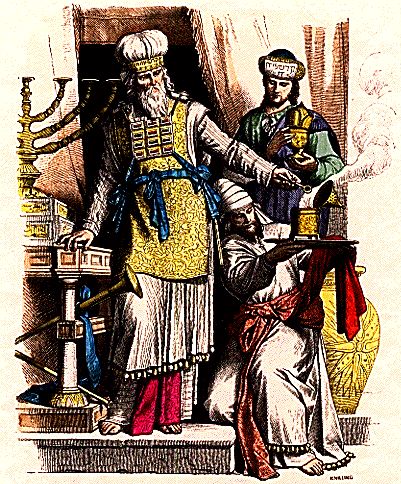
4And these are the garments which they shall make; a breastplate, and an ephod, and a robe, and a broidered coat, a mitre, and a girdle: and they shall make holy garments for Aaron thy brother, and his sons, that he may minister unto me in the priest's office.

The image to the right is from The History of Costume, by Braun & Schneider, 1861-1880. It's a jewish high priest wearing the outfit.

9And thou shalt take two onyx stones, and grave on them the names of the children of Israel:

Nobody is exactly sure the order of the names.

15And thou shalt make the breastplate of judgment with cunning work; after the work of the ephod thou shalt make it; of gold, of blue, and of purple, and of scarlet, and of fine twined linen, shalt thou make it.

Cunning work. It had better be cunning!

17And thou shalt set in it settings of stones, even four rows of stones: the first row shall be a sardius, a topaz, and a carbuncle: this shall be the first row.

18And the second row shall be an emerald, a sapphire, and a diamond.

19And the third row a ligure, an agate, and an amethyst.

20And the fourth row a beryl, and an onyx, and a jasper: they shall be set in gold in their inclosings.

Each stone represented one of the tribes/children of Israel.

Sardius is Carnelian, a reddish brown mineral, that is a semi-precious gemstone.

Topaz is a mineral of aluminum and flourine. It comes in several colors, from colorless to orange, to yellow, pink, pale green, blue, gold and other colors.

Carbuncle is an abscess larger than a boil, it is caused by a bacterial infection, it is filled with fluid, puss and dead tissue... oh wait, this carbuncle is a red cabachon cut gemstone, probably a red garnet.

Emerald is green.

Sapphires are normally blue.

Diamonds are... diamonds.

Ligures are possibly amber. No one is really sure what it is.

Agates are semi-precious, they are a style of quartz. The one used here was probably sky blue.

Amethysts are purple minerals. Supposely amethysts protect people from getting drunk. The name means not intoxicating. That gives new meaning to the Amethyst Initiative.

Beryl, there are several varieties, aquamarine, red, emerald, golden, colorless, and pink. This was probably a white beryl.

Onyx is normally black, at least we think of black onyx most. It can be most any color. It is also a type of quarts, like agate.

Jasper is a spotted or speckled stone, and that's what the name means. It can come in several colors, red, yellow, brown, green, and rarely blue.

No one is exactly sure what most of the gems are. No one is sure what the breastplate actually looked like. No one is sure who was represented by what gem. Most of the precious stones were uncut. Diamond cutting didn't begin until after the 1200's AD. Additionally, they wouldn't have had the ability to cut diamonds. The other harder stones would just be stones as well. The pretty pictures that you see as representations of the Hoshen (breastplate) are idealized artists renderings. If it has cut stones, then it's not even possible that that's what it looked like.

21And the stones shall be with the names of the children of Israel, twelve, according to their names, like the engravings of a signet; every one with his name shall they be according to the twelve tribes.

Additionally, you are to believe that a diamond was engraved.

30And thou shalt put in the breastplate of judgment the Urim and the Thummim; and they shall be upon Aaron's heart, when he goeth in before the LORD: and Aaron shall bear the judgment of the children of Israel upon his heart before the LORD continually.

Urim and Thummim. What are they, why do they get capitalized? Again, no one is exactly sure what they were, let alone what they were made of. These two objects were used for divination. They were placed in a bag, and whichever one was pulled determined the outcome. Thummim was the innocent stone while Urim was the cursed stone. Urim for guilty, Thummim for innocent. You'll note the order, implying the person was guilty until proven innocent. Except that they weren't proven, they were picked, with a 50-50 chance.

Aaron also got some more clothes to wear, as did his children.

Exodus 29

1And this is the thing that thou shalt do unto them to hallow them, to minister unto me in the priest's office: Take one young bullock, and two rams without blemish,

Oddly, Aaron and his boys don't minister to the congregation, they minister to god.

2And unleavened bread, and cakes unleavened tempered with oil, and wafers unleavened anointed with oil: of wheaten flour shalt thou make them.

Unleavened, because god hates yeast.

Then Aaron and his boys get dressed up in the Exodus 28 outfits. They put their hands on the head of the bullock...

11And thou shalt kill the bullock before the LORD, by the door of the tabernacle of the congregation.

12And thou shalt take of the blood of the bullock, and put it upon the horns of the altar with thy finger, and pour all the blood beside the bottom of the altar.

And kill it.

Then they burn the guts on the altar. They burn the skin and poop outside camp.

15Thou shalt also take one ram; and Aaron and his sons shall put their hands upon the head of the ram.

16And thou shalt slay the ram, and thou shalt take his blood, and sprinkle it round about upon the altar.

The first ram is cut up, and burned on the altar.

20Then shalt thou kill the ram, and take of his blood, and put it upon the tip of the right ear of Aaron, and upon the tip of the right ear of his sons, and upon the thumb of their right hand, and upon the great toe of their right foot, and sprinkle the blood upon the altar round about.

Then there's a bizarre ritual with putting blood on everyone.

21And thou shalt take of the blood that is upon the altar, and of the anointing oil, and sprinkle it upon Aaron, and upon his garments, and upon his sons, and upon the garments of his sons with him: and he shall be hallowed, and his garments, and his sons, and his sons' garments with him.

And with that, they are washed in the blood of the ram. They are now able to minister to god.

But what do you do with all that meat? Well, god doesn't eat it, so Aaron and his sons have to.

28And it shall be Aaron's and his sons' by a statute for ever from the children of Israel: for it is an heave offering: and it shall be an heave offering from the children of Israel of the sacrifice of their peace offerings, even their heave offering unto the LORD.

29And the holy garments of Aaron shall be his sons' after him, to be anointed therein, and to be consecrated in them.

From the exodus to ... um... forever, the animals sacrificed wind up being eaten by Aaron and his sons. Which isn't a bad job to be born into.

32And Aaron and his sons shall eat the flesh of the ram, and the bread that is in the basket by the door of the tabernacle of the congregation.

33And they shall eat those things wherewith the atonement was made, to consecrate and to sanctify them: but a stranger shall not eat thereof, because they are holy.

In fact, the food can't be feed to anyone else, it's only for the priests.

38Now this is that which thou shalt offer upon the altar; two lambs of the first year day by day continually.

39The one lamb thou shalt offer in the morning; and the other lamb thou shalt offer at even:

Every day, Aaron and his sons have to kill animals and eat them. A lamb in the morning and a lamb at night.

44And I will sanctify the tabernacle of the congregation, and the altar: I will sanctify also both Aaron and his sons, to minister to me in the priest's office.

Why Moses didn't protect his children from ever having to get a real job is beyond me. Why he set up Aaron and his boys for eternity was a nice thing to do for his brother.

Exodus 30

1And thou shalt make an altar to burn incense upon: of shittim wood shalt thou make it.

Now the tabernacle is going to be a restaurant that only serves Aaron's sons, but also, there's going to be incense being burned. So it may not be the best smelling place. Although the incense will probably cover up the smell of all the blood that's spilled everywhere.

13This they shall give, every one that passeth among them that are numbered, half a shekel after the shekel of the sanctuary: (a shekel is twenty gerahs:) an half shekel shall be the offering of the LORD.

So, not only do the Kohanim never have to work to get food, now they also get a half a shekel from everyone.

14Every one that passeth among them that are numbered, from twenty years old and above, shall give an offering unto the LORD.

Remember, there were 600,000 people who left (Exodus 12:37).

15The rich shall not give more, and the poor shall not give less than half a shekel, when they give an offering unto the LORD, to make an atonement for your souls.

God costs the same regardless of your worth.

25And thou shalt make it an oil of holy ointment, an ointment compound after the art of the apothecary: it shall be an holy anointing oil.

This is the ingredients in the anointing oil: myrrh, sweet cinnamon, sweet calamus, cassia, and olive oil. Sounds good enough.

Myrrh is one of the gifts of the three wise men. It's the dried sap of a tree. It provides an earthy smell.
Sweet cinnamon is cinnamon.
Cassia is is a relative of cinnamon.
Olive oil is olive oil. So what have we left out...

Sweet Calamus is also known as Sweet Flag. It's a tall perennial wetland monocot with scented leaves and more strongly scented rhizomes, which have been used medicinally, for its odor, and as a psychotropic drug. Wait... what??? A psychotropic drug? Currently, calamus is banned in the US because it's a drug. In high doses, it is a hallucinogenic. Why did Moses, Aaron, and his boys see god? They were tripping.

30And thou shalt anoint Aaron and his sons, and consecrate them, that they may minister unto me in the priest's office.

So after the boys are anointed in the drugged oil, they now can go minister to god.

32Upon man's flesh shall it not be poured, neither shall ye make any other like it, after the composition of it: it is holy, and it shall be holy unto you.

It's not only holy, it's a controlled substance.

God then tells Moses to make his favorite perfume. It needed to have stacte, onycha, and galbanum, along with pure frankincense. (Frankincense was one of the other things the wise men brought).

No one knows what stacte was. It's believed to be high quality myrrh. Onycha is apparently crushed up sea snail shells. Galbanum is the gum resin of the plant Ferula Gummosa.

38Whosoever shall make like unto that, to smell thereto, shall even be cut off from his people.

Anyone who makes god's own perfume will be kicked out.

Points to ponder:

1. You'd think after all these years, that the Jewish people would give up on honoring Moses wishes. Especially the part about his brothers kids never having to do any real work.

2. What do you think the priests robes looked like?

3. Do you believe that the diamond was actually cut with someone's name on it?

4. Today, leaders of religions who use drugs normally wind up either in jail, or having killed their entire flock; it's a good thing that Moses didn't lead his people to Jonestown, otherwise we wouldn't have the great moral code that the bible is.

Monday, January 25, 2010

Day 25. Exodus 25-27

Exodus 25-27

Exodus 25

2Speak unto the children of Israel, that they bring me an offering: of every man that giveth it willingly with his heart ye shall take my offering.

Today's reading is all about building. Exodus 25 is about how to build the Ark of the Covenant.

First though, god needed people to give him things to build everything with: gold, silver, brass, skins, wood, oils, and stones.

10And they shall make an ark of shittim wood: two cubits and a half shall be the length thereof, and a cubit and a half the breadth thereof, and a cubit and a half the height thereof.

Just like the thing in Indiana Jones, in Raiders of the Lost Ark.

11And thou shalt overlay it with pure gold, within and without shalt thou overlay it, and shalt make upon it a crown of gold round about.

That's a lot of gold.

16And thou shalt put into the ark the testimony which I shall give thee.

At this point, apparently, they don't have the testimony. Even though in Exodus 16:34, Aaron laid up an omer of Manna next to the testimony.

17And thou shalt make a mercy seat of pure gold: two cubits and a half shall be the length thereof, and a cubit and a half the breadth thereof.

18And thou shalt make two cherubims of gold, of beaten work shalt thou make them, in the two ends of the mercy seat.

The mercy seat is the cover.

22And there I will meet with thee, and I will commune with thee from above the mercy seat, from between the two cherubims which are upon the ark of the testimony, of all things which I will give thee in commandment unto the children of Israel.

God, himself, will talk to Moses from the mercy seat.

23Thou shalt also make a table of shittim wood: two cubits shall be the length thereof, and a cubit the breadth thereof, and a cubit and a half the height thereof.

Next, make a table, and cover it in gold.

29And thou shalt make the dishes thereof, and spoons thereof, and covers thereof, and bowls thereof, to cover withal: of pure gold shalt thou make them.

God likes to make things color coded. Remember this, if it's gold, it's for god.

31And thou shalt make a candlestick of pure gold: of beaten work shall the candlestick be made: his shaft, and his branches, his bowls, his knops, and his flowers, shall be of the same.

God needs a gold nightlight.

38And the tongs thereof, and the snuffdishes thereof, shall be of pure gold.

God even wants his candle accessories to be made of gold.

Exodus 26

1Moreover thou shalt make the tabernacle with ten curtains of fine twined linen, and blue, and purple, and scarlet: with cherubims of cunning work shalt thou make them.

Chapter 25 was the ark and things, chapter 26 is the tabernacle, or as I like to call it, the tentbernacle.

The build instructions for the tentbernacle go through verse 33.

34And thou shalt put the mercy seat upon the ark of the testimony in the most holy place.

God even tells how he would like his gold room laid out.

35And thou shalt set the table without the vail, and the candlestick over against the table on the side of the tabernacle toward the south: and thou shalt put the table on the north side.

God is kind of OCD, he wants things the way he wants them.

Exodus 27

Chapter 27 is about other things god needs built.

1And thou shalt make an altar of shittim wood, five cubits long, and five cubits broad; the altar shall be foursquare: and the height thereof shall be three cubits.

2And thou shalt make the horns of it upon the four corners thereof: his horns shall be of the same: and thou shalt overlay it with brass.

These items are to be overlaid with brass. God's things are gold, the brass things are for the priests.

6And thou shalt make staves for the altar, staves of shittim wood, and overlay them with brass.

Staves are the carrying sticks.

10And the twenty pillars thereof and their twenty sockets shall be of brass; the hooks of the pillars and their fillets shall be of silver.

Pillars of brass, and fillets of silver.

21In the tabernacle of the congregation without the vail, which is before the testimony, Aaron and his sons shall order it from evening to morning before the LORD: it shall be a statute for ever unto their generations on the behalf of the children of Israel.

Verse 20 talks about keeping a lamp lit. Here we see that Aaron and his sons are the ones to do it.

There really isn't that much else going on in today's readings. I've read this one before, and this is about as exciting as I can make it.

Points to ponder:

1. The people didn't have time to let their bread rise, but they had enough time to gather enough gold to make these items. They had enough time to gather enough fabric to make a huge tent.

2. Gold things for god, brass for the priests. There will be more colors coming up later.

3. The tabernacle was carried with the people from the point they made it in the wilderness through the age of judges, all the way up to the third king. Either the people lacked initiative, or god likes his tents. He actually likes the tents.