Showing posts with label joseph. Show all posts

Thursday, January 21, 2010

Day 21. Exodus 13-15

Exodus 13-15

Exodus 13

3And Moses said unto the people, Remember this day, in which ye came out from Egypt, out of the house of bondage; for by strength of hand the LORD brought you out from this place: there shall no leavened bread be eaten.

What an interesting statement.

REMEMBER THIS DAY, IN WHICH YE CAME OUT OF EGYPT!!!

Don't eat leavened bread.

It's like at the original woodstock.


4This day came ye out in the month Abib.

Abib means barley. It is another name for the month of Nisan.

5And it shall be when the LORD shall bring thee into the land of the Canaanites, and the Hittites, and the Amorites, and the Hivites, and the Jebusites, which he sware unto thy fathers to give thee, a land flowing with milk and honey, that thou shalt keep this service in this month.

6Seven days thou shalt eat unleavened bread, and in the seventh day shall be a feast to the LORD.

There's a whole lot of grains going on here. It's the month of grain, and they are told to not let their grain be corrupted by yeast.

7Unleavened bread shall be eaten seven days; and there shall no leavened bread be seen with thee, neither shall there be leaven seen with thee in all thy quarters.

8And thou shalt shew thy son in that day, saying, This is done because of that which the LORD did unto me when I came forth out of Egypt.

Moses is sure giving orders for far in the future. Except he doesn't know it's going to be far in the future. He thinks it'll be like when Jacob and his went into Egypt. That it was just a simple little trek. He thinks they'll probably be in the promised land in about a week.

17And it came to pass, when Pharaoh had let the people go, that God led them not through the way of the land of the Philistines, although that was near; for God said, Lest peradventure the people repent when they see war, and they return to Egypt:

18But God led the people about, through the way of the wilderness of the Red sea: and the children of Israel went up harnessed out of the land of Egypt.

God didn't let them go directly into the land. He knew it was occupied, he knew the people who lived there wouldn't just give it up to this new horde of people. He knew that these weak willed people would turn and run back to their bondage at the first sign of trouble. So, to make them want it more... he put them on a little journey.

19And Moses took the bones of Joseph with him: for he had straitly sworn the children of Israel, saying, God will surely visit you; and ye shall carry up my bones away hence with you.

Remember, Joseph died in Egypt and was embalmed there.

21And the LORD went before them by day in a pillar of a cloud, to lead them the way; and by night in a pillar of fire, to give them light; to go by day and night:

22He took not away the pillar of the cloud by day, nor the pillar of fire by night, from before the people.

The people were personally being led around by god. He was a cloud during the day and fire by night.

Exodus 14

2Speak unto the children of Israel, that they turn and encamp before Pihahiroth, between Migdol and the sea, over against Baalzephon: before it shall ye encamp by the sea.

There are 42 stations where the people stopped on their journey. The first was Raamses, the second was Sukkoth, the third is Etham. We are now at Pi-Hahiroth. No one is exactly sure where this place is.

3For Pharaoh will say of the children of Israel, They are entangled in the land, the wilderness hath shut them in.

We are to believe that pharaoh believes the people are coming back. This must have been about a week into the journey. Pharaoh expected them back by now. Three days out, three days back, a day or more to do the sacrifices.

4And I will harden Pharaoh's heart, that he shall follow after them; and I will be honoured upon Pharaoh, and upon all his host; that the Egyptians may know that I am the LORD. And they did so.

5And it was told the king of Egypt that the people fled: and the heart of Pharaoh and of his servants was turned against the people, and they said, Why have we done this, that we have let Israel go from serving us?

God again hardens pharaoh's heart. Then someone told him that the people weren't coming back.

6And he made ready his chariot, and took his people with him:

7And he took six hundred chosen chariots, and all the chariots of Egypt, and captains over every one of them.

So Pharaoh took pretty much his entire army to get the slaves back.

10And when Pharaoh drew nigh, the children of Israel lifted up their eyes, and, behold, the Egyptians marched after them; and they were sore afraid: and the children of Israel cried out unto the LORD.

The people were afraid. They had their god there in a cloud, and they were still afraid. They wondered why they left Egypt to go die in the wilderness.

13And Moses said unto the people, Fear ye not, stand still, and see the salvation of the LORD, which he will shew to you to day: for the Egyptians whom ye have seen to day, ye shall see them again no more for ever.

14The LORD shall fight for you, and ye shall hold your peace.

If the LORD was going to fight for them, why didn't he just take them into Canaan then?

God tells Moses to lift up his magic stick and part the sea.

19And the angel of God, which went before the camp of Israel, removed and went behind them; and the pillar of the cloud went from before their face, and stood behind them:

The cloud got in between the people and the Egyptians. That's why they didn't overtake them right there at the shore.

21And Moses stretched out his hand over the sea; and the LORD caused the sea to go back by a strong east wind all that night, and made the sea dry land, and the waters were divided.

22And the children of Israel went into the midst of the sea upon the dry ground: and the waters were a wall unto them on their right hand, and on their left.

Some people will argue that the ground was completely dry. That the people never even touched a drop of water on their trip across.

23And the Egyptians pursued, and went in after them to the midst of the sea, even all Pharaoh's horses, his chariots, and his horsemen.

That was a mistake.

God then removed the wheels from the chariots, so that they got stuck in the muck... that was there for the Egyptians, but not the Israelites.

27And Moses stretched forth his hand over the sea, and the sea returned to his strength when the morning appeared; and the Egyptians fled against it; and the LORD overthrew the Egyptians in the midst of the sea.

28And the waters returned, and covered the chariots, and the horsemen, and all the host of Pharaoh that came into the sea after them; there remained not so much as one of them.

If the entire army of Egypt was destroyed, why didn't they take over Egypt? Why didn't any other country invade and take over Egypt. Why is there no record of Egypt suddenly becoming completely weak.

31And Israel saw that great work which the LORD did upon the Egyptians: and the people feared the LORD, and believed the LORD, and his servant Moses.

It won't last.

Exodus 15

The first part of this chapter is the song the people made up when they saw that all the Egyptians were dead. Here's some highlights.

3The LORD is a man of war: the LORD is his name.

...

4Pharaoh's chariots and his host hath he cast into the sea: his chosen captains also are drowned in the Red sea.
...

10Thou didst blow with thy wind, the sea covered them: they sank as lead in the mighty waters.
...

13Thou in thy mercy hast led forth the people which thou hast redeemed: thou hast guided them in thy strength unto thy holy habitation.
...
16Fear and dread shall fall upon them; by the greatness of thine arm they shall be as still as a stone; till thy people pass over, O LORD, till the people pass over, which thou hast purchased.


I like how verse 13 talks about his mercy. While the rest of the song talks about drowning the Egyptians. I guess it depends upon perspective. God was merciful to his people, to the Egyptians, not so much. Don't forget, he caused Pharaoh to chase the people. Pharaoh had no choice in the matter, whenever he was going to let the people go, god hardened his heart. Then god killed all the people. That is mercy.

20And Miriam the prophetess, the sister of Aaron, took a timbrel in her hand; and all the women went out after her with timbrels and with dances.

Moses had a sister. This is the first mention of her.

22So Moses brought Israel from the Red sea, and they went out into the wilderness of Shur; and they went three days in the wilderness, and found no water.

They are now coming to the next station.

23And when they came to Marah, they could not drink of the waters of Marah, for they were bitter: therefore the name of it was called Marah.

Was it named Marah before, or did the people name it? Marah means bitter.

25And he cried unto the LORD; and the LORD shewed him a tree, which when he had cast into the waters, the waters were made sweet: there he made for them a statute and an ordinance, and there he proved them,

This was apparently barberry, which has the ability to sweeten brackish water.
27And they came to Elim, where were twelve wells of water, and threescore and ten palm trees: and they encamped there by the waters.

Next stop, Elim. Elim probably means trees. There were 70 of them there. Are 70 trees enough to feed 600,000 people? Apparently it is.

Points to ponder:

1. Mercy is all based on perspective. In order to receive mercy, there also has to be the ability for the merciful to perform destruction. If a child with a magnifying glass only starts a couple of ants on fire, he was merciful to the ones he didn't ignite.

2. Do you believe the parting of the waters story?

3. Why didn't some other country overthrow Egypt after the entire army was destroyed?

Saturday, January 16, 2010

Day 16. Genesis 47-50

Genesis 47-50

Genesis 47

1Then Joseph came and told Pharaoh, and said, My father and my brethren, and their flocks, and their herds, and all that they have, are come out of the land of Canaan; and, behold, they are in the land of Goshen.

Goshen was some of the (but not the) best land in Egypt. It's in the north east of the country. The name Goshen doesn't really mean anything. The area is now a desert.

Joseph presents five of his brothers to pharaoh.

3And Pharaoh said unto his brethren, What is your occupation? And they said unto Pharaoh, Thy servants are shepherds, both we, and also our fathers.

Darn it; Joseph said they were supposed to say cattle ranchers because shepherding is an abomination.

7And Joseph brought in Jacob his father, and set him before Pharaoh: and Jacob blessed Pharaoh.

There wasn't always contention between the Hebrews and the Egyptians.

8And Pharaoh said unto Jacob, How old art thou?

9And Jacob said unto Pharaoh, The days of the years of my pilgrimage are an hundred and thirty years: few and evil have the days of the years of my life been, and have not attained unto the days of the years of the life of my fathers in the days of their pilgrimage.

Ok, if Jacob is 130, that means that it is 1766.

11And Joseph placed his father and his brethren, and gave them a possession in the land of Egypt, in the best of the land, in the land of Rameses, as Pharaoh had commanded.

Ramesses means "Born of the god Ra". Messes means "born of the god". Amenmesse means "born of the god Amun".

13And there was no bread in all the land; for the famine was very sore, so that the land of Egypt and all the land of Canaan fainted by reason of the famine.

The famine was getting worse. The first two years, there was still plenty. Now, things are getting pretty bad.

14And Joseph gathered up all the money that was found in the land of Egypt, and in the land of Canaan, for the corn which they bought: and Joseph brought the money into Pharaoh's house.

First, Joseph managed to get all the money from the people, in exchange for corn.

15And when money failed in the land of Egypt, and in the land of Canaan, all the Egyptians came unto Joseph, and said, Give us bread: for why should we die in thy presence? for the money faileth.

The famine (with the help of Joseph) ruined the economy of Egypt.

16And Joseph said, Give your cattle; and I will give you for your cattle, if money fail.

17And they brought their cattle unto Joseph: and Joseph gave them bread in exchange for horses, and for the flocks, and for the cattle of the herds, and for the asses: and he fed them with bread for all their cattle for that year.

After Joseph took all the money from the land. He then took all the livestock, in exchange for corn. Why didn't these people ever eat their livestock? Jacob and all his people came down with a whole lot of livestock. Why didn't they eat it? Does no one eat cows? Oh yeah, probably not.

And now, for a discussion of Astrological Ages. Each age is roughly 2000 years.

We are currently (or just about to go into) the Age of Aquarius. Yes, like the musical Hair says, "this is the dawning of the Age of Aquarius". The astrological ages proceed backwards from the order of the zodiac. We haven't gotten our great messiah for this age yet (I'll do it). Aquarius would last from about 2000-4000 AD.

The age that is either ending, or just ended was the age of Pisces. The great messiah for that age was Jesus. The symbol of Pisces is a fish. One of the symbols that people use to represent Jesus is the Ichthus (the Jesus fish). (pronounced Ikh-thoos) It is the greek word for fish. Pisces would have lasted from about 0-2000 AD.

The age before that was the Age of Aries. Aries is the ram. The great messiah for that age was Moses. Moses is often depicted with rams horns, known as Horned Moses, (we'll get to more of that in a couple of days). Remember, Isaac was about to be sacrifice, and then a ram was stuck in the bushes and it was sacrificed instead. Isaac was born in 1956, right at the beginning of the age of Aries. Aries would have been from 0-2000 BC.

The age before that was Taurus. Taurus is the bull. That era would have been from 2000-4000 BC (the first day). Bulls were sacred animals in Egypt during this time. So people wouldn't have eaten them.

So, since they were at the end of the age of Taurus, the people wouldn't eat their sacred animals.

Back to the bible.

18When that year was ended, they came unto him the second year, and said unto him, We will not hide it from my lord, how that our money is spent; my lord also hath our herds of cattle; there is not ought left in the sight of my lord, but our bodies, and our lands:

19Wherefore shall we die before thine eyes, both we and our land? buy us and our land for bread, and we and our land will be servants unto Pharaoh: and give us seed, that we may live, and not die, that the land be not desolate.

Joseph has the money, the livestock, and now he's taking the land and the people.

20And Joseph bought all the land of Egypt for Pharaoh; for the Egyptians sold every man his field, because the famine prevailed over them: so the land became Pharaoh's.

21And as for the people, he removed them to cities from one end of the borders of Egypt even to the other end thereof.

He turned the farming civilization into people who lived in cities. He didn't buy the land of the priests. After purchasing the land, he allowed people to go farm on it, in return for 20% of the harvest.

26And Joseph made it a law over the land of Egypt unto this day, that Pharaoh should have the fifth part, except the land of the priests only, which became not Pharaoh's.

Apparently the bible is correct, from what I can tell, Egypt currently has a progressive income tax rate from 20 to 40 percent.

27And Israel dwelt in the land of Egypt, in the country of Goshen; and they had possessions therein, and grew, and multiplied exceedingly.

28And Jacob lived in the land of Egypt seventeen years: so the whole age of Jacob was an hundred forty and seven years.

Jacob is preparing to die.

29And the time drew nigh that Israel must die: and he called his son Joseph, and said unto him, If now I have found grace in thy sight, put, I pray thee, thy hand under my thigh, and deal kindly and truly with me; bury me not, I pray thee, in Egypt:

30But I will lie with my fathers, and thou shalt carry me out of Egypt, and bury me in their buryingplace. And he said, I will do as thou hast said.

31And he said, Swear unto me. And he sware unto him. And Israel bowed himself upon the bed's head.

This is another testicle/ballsack/circumcision swear. "Under my thigh" means the testes, or on the circumcision.

Either way, Jacob didn't want to be buried in Egypt (he's a racist), he wanted to be buried in the cave of the patriarchs.

Genesis 48

Jacob takes his two boys in to see their grandfather and be blessed.

5And now thy two sons, Ephraim and Manasseh, which were born unto thee in the land of Egypt before I came unto thee into Egypt, are mine; as Reuben and Simeon, they shall be mine.

As Reuben and Simeon, they shall be mine. What Jacob means is, INSTEAD of Reuben and Simeon, they shall be mine. Jacob was still pissed at Reuben for sleeping with Bilhah. Jacob was pissed at Simeon for killing all the people in Shechem.

8And Israel beheld Joseph's sons, and said, Who are these?

What? In the 17 years that Jacob lived in Israel, he never met Joseph's boys?

In recent reading we saw how the notions of Benjamin were incorrect. How he's portrayed as a child of around 10 years old when he meets Joseph in Egypt. Meanwhile he moves down into Egypt with 10 children. Today we get another example of how people get it wrong.

The picture to the right is Jacob Blessing Ephraim and Manasseh, by Benjamin West. This was painted in 1766-68. The picture hangs in the Allen Memorial Art Museum, Oberlin College, Oberlin, Ohio.

You see Jacob, an old man, blessing two young children. Manasseh is the darker haired child.

In Genesis 41:50, we see the sons were born before the years of famine. Jacob moved into Egypt in the second year of the famine. Jacob dies after living there for 17 years. Jacob dies after giving the blessings. The boys would have been nearly 20, and not children.

9And Joseph said unto his father, They are my sons, whom God hath given me in this place. And he said, Bring them, I pray thee, unto me, and I will bless them.

Joseph introduces his sons.

12And Joseph brought them out from between his knees, and he bowed himself with his face to the earth.

This verse makes it seem as though the boys were children. We'll have to keep reading to ensure that they are men, and not young boys.

13And Joseph took them both, Ephraim in his right hand toward Israel's left hand, and Manasseh in his left hand toward Israel's right hand, and brought them near unto him.

14And Israel stretched out his right hand, and laid it upon Ephraim's head, who was the younger, and his left hand upon Manasseh's head, guiding his hands wittingly; for Manasseh was the firstborn.

Ephraim got the right hand (so he'd be the blond child in the painting).

15And he blessed Joseph, and said, God, before whom my fathers Abraham and Isaac did walk, the God which fed me all my life long unto this day,

16The Angel which redeemed me from all evil, bless the lads; and let my name be named on them, and the name of my fathers Abraham and Isaac; and let them grow into a multitude in the midst of the earth.

God bless these boys.

17And when Joseph saw that his father laid his right hand upon the head of Ephraim, it displeased him: and he held up his father's hand, to remove it from Ephraim's head unto Manasseh's head.

18And Joseph said unto his father, Not so, my father: for this is the firstborn; put thy right hand upon his head.

It's funny that Jacob wants his sons blessed in their birth order. He's usurping his oldest brothers blessing, by getting his boys blessed first. He's also getting the primary blessing from the son who usurped it from the deserving brother (Esau). Who got his blessing from the father who sent away his firstborn (Ishmael) to go die in the desert.

19And his father refused, and said, I know it, my son, I know it: he also shall become a people, and he also shall be great: but truly his younger brother shall be greater than he, and his seed shall become a multitude of nations.

The younger sons always seem to be the ones who are greater.

22Moreover I have given to thee one portion above thy brethren, which I took out of the hand of the Amorite with my sword and with my bow.

I don't remember that story.

Genesis 49

1And Jacob called unto his sons, and said, Gather yourselves together, that I may tell you that which shall befall you in the last days.

Jacob calls his sons together. It's time for them to be blessed.

First he insults Reuben, for sleeping with his concubine. (1)

4Unstable as water, thou shalt not excel; because thou wentest up to thy father's bed; then defiledst thou it: he went up to my couch.

Then he insults Simeon and Levi, for killing Shechem.(2,3)

7Cursed be their anger, for it was fierce; and their wrath, for it was cruel: I will divide them in Jacob, and scatter them in Israel.

Judah is the first to get something nice said to him. (4)

8Judah, thou art he whom thy brethren shall praise: thy hand shall be in the neck of thine enemies; thy father's children shall bow down before thee.

Zebulon: (5)

13Zebulun shall dwell at the haven of the sea; and he shall be for an haven of ships; and his border shall be unto Zidon.

Issachar: (6)

14Issachar is a strong ass couching down between two burdens:

Dan: (7)

16Dan shall judge his people, as one of the tribes of Israel.

Gad: (8)

19Gad, a troop shall overcome him: but he shall overcome at the last.

Asher: (9)

20Out of Asher his bread shall be fat, and he shall yield royal dainties.

Naphtali: (10)

21Naphtali is a hind let loose: he giveth goodly words.

Joseph: (11)

22Joseph is a fruitful bough, even a fruitful bough by a well; whose branches run over the wall:

Benjamin: (12)

27Benjamin shall ravin as a wolf: in the morning he shall devour the prey, and at night he shall divide the spoil.

It seems like some of those are just the ravings of a dieing man. They don't seem like blessings at all.

28All these are the twelve tribes of Israel: and this is it that their father spake unto them, and blessed them; every one according to his blessing he blessed them.

Those are the blessings.

Then he demanded to be buried in the cave of the patriarchs.

33And when Jacob had made an end of commanding his sons, he gathered up his feet into the bed, and yielded up the ghost, and was gathered unto his people.

Then he died.

Exactly when did all the blessings take place? We know the final blessings happened in 1749, right before he died. The narrative seems to imply that the 12 blessings happened almost directly after the Manasseh/ Ephraim blessings. Which would put it at 17 years after Jacob went to Egypt, making those two boys nearly 20.

Genesis 50

1And Joseph fell upon his father's face, and wept upon him, and kissed him.

2And Joseph commanded his servants the physicians to embalm his father: and the physicians embalmed Israel.

This is the first mention of embalming. There is only one other Hebrew who was embalmed, and that's later, in verse 26.

Joseph tells Pharaoh that he wants to go bury his dad at the cave of the patriarchs.

Pharaoh lets him go.

12And his sons did unto him according as he commanded them:

13For his sons carried him into the land of Canaan, and buried him in the cave of the field of Machpelah, which Abraham bought with the field for a possession of a buryingplace of Ephron the Hittite, before Mamre.

Jacob was buried next to Leah. Rachel was buried someplace else. Jacob may have loved Rachel more, but the person he was buried with was Leah.

14And Joseph returned into Egypt, he, and his brethren, and all that went up with him to bury his father, after he had buried his father.

The brothers went back. The famine was over. They didn't need to go back. They could have stayed, if they did, we wouldn't have a whole lot of the religions that are out there now. There would have been no exodus. There wouldn't be the plagues. There wouldn't be passover. Jesus wouldn't have been sacrificed on passover.

The brothers are then afraid that Joseph will now punish them. They thought that maybe he was being nice because of Jacob.

17So shall ye say unto Joseph, Forgive, I pray thee now, the trespass of thy brethren, and their sin; for they did unto thee evil: and now, we pray thee, forgive the trespass of the servants of the God of thy father. And Joseph wept when they spake unto him.

Joseph was sad that they thought he would do them harm.

20But as for you, ye thought evil against me; but God meant it unto good, to bring to pass, as it is this day, to save much people alive.

21Now therefore fear ye not: I will nourish you, and your little ones. And he comforted them, and spake kindly unto them.

Joseph promises to take care of his brothers families.

22And Joseph dwelt in Egypt, he, and his father's house: and Joseph lived an hundred and ten years.

23And Joseph saw Ephraim's children of the third generation: the children also of Machir the son of Manasseh were brought up upon Joseph's knees.

Joseph actually took part in the lives of his grand children. Which is odd, since no one else seems to have taken an interest in their grandkids. Noah cursed one of his. Jacob blessed Ephraim and Manasseh, but didn't know who they were. No one seemed to care about anyone except their favorite.

26So Joseph died, being an hundred and ten years old: and they embalmed him, and he was put in a coffin in Egypt.

Joseph finally died.

Thus ends Genesis.

Points to ponder:

1. Is it right to take all the money, then take the livestock, then take the land, then take the people? If the stored food was a fifth, didn't the people have a right to the food they put up?

2. We Manasseh and Ephraim children, or were they in their late teens?

3. Why did they go back to Egypt after burying Jacob?

Friday, January 15, 2010

Day 15. Genesis 43-46

Genesis 43-46

Genesis 43

1And the famine was sore in the land.

2And it came to pass, when they had eaten up the corn which they had brought out of Egypt, their father said unto them, Go again, buy us a little food.

They had used up all the provisions and had to go back and get more. In the meantime, according to Gen. 42:24, Simeon was locked up in Egypt's prison system.

Judah tells Jacob (Israel) that they aren't supposed to go back down there unless they take Benjamin with them.

6And Israel said, Wherefore dealt ye so ill with me, as to tell the man whether ye had yet a brother?

Jacob is wondering, why did you tell this man you had another brother?

7And they said, The man asked us straitly of our state, and of our kindred, saying, Is your father yet alive? have ye another brother? and we told him according to the tenor of these words: could we certainly know that he would say, Bring your brother down?

It's as though he knew...

Judah tells Jacob to send Benjamin with him.

8And Judah said unto Israel his father, Send the lad with me, and we will arise and go; that we may live, and not die, both we, and thou, and also our little ones.

Benjamin here, is referred to as "the lad". Why? During this time, Benjamin is always drawn as a child.

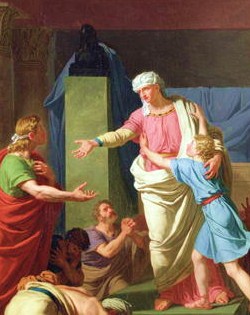
The picture to the right is from 1789, by Charles Thevenin, Joseph und seine Brüder. You see Benjamin as just a youth, probably not even a teenager. The rest of the brothers seem to vary in age.

Artists seem to take some freedoms when dealing with the family. Seemingly forgetting that the first son was born AFTER Jacob married Rachel (after the 14 years) and that Joseph was the last son born before Jacob asked to leave Laban. The first 11 boys (and Dinah) were born in only a 6 year period. The boys are all relatively close in age, on average separated by only 6 months. Leah managed to have 7 children in that six year period. There are 72 months in 6 years, Leah was pregnant for 63 of them.

Back to today...

11And their father Israel said unto them, If it must be so now, do this; take of the best fruits in the land in your vessels, and carry down the man a present, a little balm, and a little honey, spices, and myrrh, nuts, and almonds:

12And take double money in your hand; and the money that was brought again in the mouth of your sacks, carry it again in your hand; peradventure it was an oversight:

Well, there was still some food in the land, but you aren't going to make a staple diet out of those things.

13Take also your brother, and arise, go again unto the man:

14And God Almighty give you mercy before the man, that he may send away your other brother, and Benjamin. If I be bereaved of my children, I am bereaved.

Your other brother... what's his name... Simeon.

16And when Joseph saw Benjamin with them, he said to the ruler of his house, Bring these men home, and slay, and make ready; for these men shall dine with me at noon.

17And the man did as Joseph bade; and the man brought the men into Joseph's house.

Joseph just had to assume the person that went with his brothers was Benjamin. If Ben was just a child, then it's at least 9 years later, his brothers didn't recognize him, why would he recognize a younger brother?

The brothers are surprised about being taken into "the man's" house. They tell his servant they don't know why their money was returned.

23And he said, Peace be to you, fear not: your God, and the God of your father, hath given you treasure in your sacks: I had your money. And he brought Simeon out unto them.

Simeon was given back to the other 10 brothers.

27And he asked them of their welfare, and said, Is your father well, the old man of whom ye spake? Is he yet alive?

28And they answered, Thy servant our father is in good health, he is yet alive. And they bowed down their heads, and made obeisance.

Joseph was glad to hear his dad was still alive. He sees his brother, and he gets all weepy, just like his dad when Jacob saw Rachel.

30And Joseph made haste; for his bowels did yearn upon his brother: and he sought where to weep; and he entered into his chamber, and wept there.

He didn't want to cry in front of his brothers.

32And they set on for him by himself, and for them by themselves, and for the Egyptians, which did eat with him, by themselves: because the Egyptians might not eat bread with the Hebrews; for that is an abomination unto the Egyptians.

So, the Egyptians never ate bread with Hebrews? Joseph was married to an Egyptian, did she ever eat with him? Joseph was the #2 guy in Egypt, but to eat with him was an abomination? I don't think this part of the story makes any sense.

34And he took and sent messes unto them from before him: but Benjamin's mess was five times so much as any of their's. And they drank, and were merry with him.

Joseph, like his father before him, played favorites.

Genesis 44

1And he commanded the steward of his house, saying, Fill the men's sacks with food, as much as they can carry, and put every man's money in his sack's mouth.

2And put my cup, the silver cup, in the sack's mouth of the youngest, and his corn money. And he did according to the word that Joseph had spoken.

Joseph's going to Punk his brothers again.

4And when they were gone out of the city, and not yet far off, Joseph said unto his steward, Up, follow after the men; and when thou dost overtake them, say unto them, Wherefore have ye rewarded evil for good?

5Is not this it in which my lord drinketh, and whereby indeed he divineth? ye have done evil in so doing.

He's having his steward ask why they stole his things. The brothers said, they didn't take anything, then they say something really stupid.

9With whomsoever of thy servants it be found, both let him die, and we also will be my lord's bondmen.

So the steward starts going through the sacks.

12And he searched, and began at the eldest, and left at the youngest: and the cup was found in Benjamin's sack.

Ohhhhh, fuuuuuddddddgggggeeeee. Only I didn't say "Fudge." I said THE word, the big one, the queen-mother of dirty words, the "F-dash-dash-dash" word!

13Then they rent their clothes, and laded every man his ass, and returned to the city.

14And Judah and his brethren came to Joseph's house; for he was yet there: and they fell before him on the ground.

15And Joseph said unto them, What deed is this that ye have done? wot ye not that such a man as I can certainly divine?

Joseph is like, I knew it was you guys who did it, I'm the all powerful Zaphnathpaaneah, I know when people steal from me...

Judah apologized.

17And he said, God forbid that I should do so: but the man in whose hand the cup is found, he shall be my servant; and as for you, get you up in peace unto your father.

Judah then says, please, don't take the boy. They retell the whole story of how Jacob didn't want to send Benjamin, but they promise they'll take care of him. Also, if Benjamin is taken, their father will die.

33Now therefore, I pray thee, let thy servant abide instead of the lad a bondman to my lord; and let the lad go up with his brethren.

34For how shall I go up to my father, and the lad be not with me? lest peradventure I see the evil that shall come on my father.

Judah says, you might as well take me, because if you keep Benjamin, not only will dad die, but he's going to take me out first.

Genesis 45

1Then Joseph could not refrain himself before all them that stood by him; and he cried, Cause every man to go out from me. And there stood no man with him, while Joseph made himself known unto his brethren.

Joseph says "YOU JUST GOT PUNK'D". Actually, he was relieved, because he didn't know how much longer he could keep up the charade.

3And Joseph said unto his brethren, I am Joseph; doth my father yet live? And his brethren could not answer him; for they were troubled at his presence.

The brothers are slightly more scared of Zaphnathpaaneah, now than they were a second ago. They realize that he (Joseph) is happy to see Benjamin; however, they are really really scared that he's going to hold a grudge for that whole "put him in a pit, then sell him into slavery" thing.

5Now therefore be not grieved, nor angry with yourselves, that ye sold me hither: for God did send me before you to preserve life.

Joseph says that God put him there, so he could take care of his family.

6For these two years hath the famine been in the land: and yet there are five years, in the which there shall neither be earing nor harvest.

This is two years into the 7 years of famine. Now we can figure out some more dates, and clear up the timeline a bit (maybe). We are still going to need a couple more dates to get the whole thing correct-ish.

8So now it was not you that sent me hither, but God: and he hath made me a father to Pharaoh, and lord of all his house, and a ruler throughout all the land of Egypt.

9Haste ye, and go up to my father, and say unto him, Thus saith thy son Joseph, God hath made me lord of all Egypt: come down unto me, tarry not:

Joseph says for them to move down, go get dad, and move down here.

13And ye shall tell my father of all my glory in Egypt, and of all that ye have seen; and ye shall haste and bring down my father hither.

Hurry, go get dad.

16And the fame thereof was heard in Pharaoh's house, saying, Joseph's brethren are come: and it pleased Pharaoh well, and his servants.

17And Pharaoh said unto Joseph, Say unto thy brethren, This do ye; lade your beasts, and go, get you unto the land of Canaan;

18And take your father and your households, and come unto me: and I will give you the good of the land of Egypt, and ye shall eat the fat of the land.

Even Pharaoh wants the family to move down.

The brothers leave, with moving vans; even though they were told to just go down, Egypt will provide. They make it home, and tell Jacob that Joseph was alive.

28And Israel said, It is enough; Joseph my son is yet alive: I will go and see him before I die.

Jacob says he'll make the journey.

Genesis 46

Jacob goes to Beersheba and offers some sacrifices to god, and asks if he should go to Egypt.

3And he said, I am God, the God of thy father: fear not to go down into Egypt; for I will there make of thee a great nation:

4I will go down with thee into Egypt; and I will also surely bring thee up again: and Joseph shall put his hand upon thine eyes.

God says it's ok to go.

6And they took their cattle, and their goods, which they had gotten in the land of Canaan, and came into Egypt, Jacob, and all his seed with him:

7His sons, and his sons' sons with him, his daughters, and his sons' daughters, and all his seed brought he with him into Egypt.

Now we get a list of everyone who went. It's not a very interesting list, mostly. There are some highlights.

12And the sons of Judah; Er, and Onan, and Shelah, and Pharez, and Zarah: but Er and Onan died in the land of Canaan. And the sons of Pharez were Hezron and Hamul.

Er and Onan are listed. It doesn't say what they did with Tamar. If they took her to Egypt, they probably would have told the "she's my sister story".

21And the sons of Benjamin were Belah, and Becher, and Ashbel, Gera, and Naaman, Ehi, and Rosh, Muppim, and Huppim, and Ard.

Wait... what? Benjamin had sons? Benjamin had 10 sons that went down into Egypt. Look at that picture up there of Joseph and Benjamin. That picture is a representation of an even that took place a couple of weeks (months at the most) before everyone moved down into Egypt. That person had 10 sons. You have been deceived.

26All the souls that came with Jacob into Egypt, which came out of his loins, besides Jacob's sons' wives, all the souls were threescore and six;

66 people, besides wives, went to Egypt.

29And Joseph made ready his chariot, and went up to meet Israel his father, to Goshen, and presented himself unto him; and he fell on his neck, and wept on his neck a good while.

30And Israel said unto Joseph, Now let me die, since I have seen thy face, because thou art yet alive.

Move over Benjamin, daddy's favorite is back.

Joseph then tells his father that when Pharaoh asks what he does, say that you were a cattle guy.

34That ye shall say, Thy servants' trade hath been about cattle from our youth even until now, both we, and also our fathers: that ye may dwell in the land of Goshen; for every shepherd is an abomination unto the Egyptians.

So, it's sheep that Egyptians had a problem with.

Points to ponder:

1. Is it alright to play tricks on your brothers? Tricks that wind up getting one of them thrown in jail.

2. When you think of Benjamin, do you think of him as old enough to have fathered children? Do you fall into the normal thinking that he was just a child. Remember, Joseph was 17 when he started dreaming (there were 11 sheafs, so Benjamin was alive), then he was 30 when he stood in front of Pharaoh the first time (add 13). Then there were the 7 years of plenty, (37) then we are now at 2 years of famine (minimum of 39). If Benjamin was only a newborn when Joseph was 17, he's still at least 22 now. Yet he's depicted as a child.

Thursday, January 14, 2010

Day 14. Genesis 40-42

Genesis 40-42

Genesis 40

1And it came to pass after these things, that the butler of the king of Egypt and his baker had offended their lord the king of Egypt.

The butler and the baker. We aren't told what the offense is, we just know that they were sent to prison. Joseph was put in charge of the two prisoners.

5And they dreamed a dream both of them, each man his dream in one night, each man according to the interpretation of his dream, the butler and the baker of the king of Egypt, which were bound in the prison.

Both had a dream. Neither could figure out what it meant.

9And the chief butler told his dream to Joseph, and said to him, In my dream, behold, a vine was before me;

10And in the vine were three branches: and it was as though it budded, and her blossoms shot forth; and the clusters thereof brought forth ripe grapes:

11And Pharaoh's cup was in my hand: and I took the grapes, and pressed them into Pharaoh's cup, and I gave the cup into Pharaoh's hand.

The chief butler was actually the cup bearer. He dreamed he would be giving Pharaoh a cup again. He couldn't figure out what his dream meant.

Joseph interpreted the dream.

12And Joseph said unto him, This is the interpretation of it: The three branches are three days:

13Yet within three days shall Pharaoh lift up thine head, and restore thee unto thy place: and thou shalt deliver Pharaoh's cup into his hand, after the former manner when thou wast his butler.

It took a professional dream interpreter to tell him that.

14But think on me when it shall be well with thee, and shew kindness, I pray thee, unto me, and make mention of me unto Pharaoh, and bring me out of this house:

15For indeed I was stolen away out of the land of the Hebrews: and here also have I done nothing that they should put me into the dungeon.

Joseph says he doesn't want to be in prison for ever. Maybe you could tell the pharaoh, and I can get out of prison.

The chief baker tells Joseph his dream.

16When the chief baker saw that the interpretation was good, he said unto Joseph, I also was in my dream, and, behold, I had three white baskets on my head:

17And in the uppermost basket there was of all manner of bakemeats for Pharaoh; and the birds did eat them out of the basket upon my head.

Joseph interprets the dream.

19Yet within three days shall Pharaoh lift up thy head from off thee, and shall hang thee on a tree; and the birds shall eat thy flesh from off thee.

The cup bearer will be restored, the baker will die.

20And it came to pass the third day, which was Pharaoh's birthday, that he made a feast unto all his servants: and he lifted up the head of the chief butler and of the chief baker among his servants.

21And he restored the chief butler unto his butlership again; and he gave the cup into Pharaoh's hand:

22But he hanged the chief baker: as Joseph had interpreted to them.

Pharaoh had a birthday party. In celebration, he restored one of the guys; he killed the other one.

23Yet did not the chief butler remember Joseph, but forgat him.

Of course he forgot him.

Genesis 41

1And it came to pass at the end of two full years, that Pharaoh dreamed: and, behold, he stood by the river.

Pharaoh now has a dream.

2And, behold, there came up out of the river seven well favoured kine and fatfleshed; and they fed in a meadow.

3And, behold, seven other kine came up after them out of the river, ill favoured and leanfleshed; and stood by the other kine upon the brink of the river.

4And the ill favoured and leanfleshed kine did eat up the seven well favoured and fat kine. So Pharaoh awoke.

Kine are cattle. Seven fat cows came out of the river, then seven skinny cows came out and ate the fat cows.

He had another dream.

5And he slept and dreamed the second time: and, behold, seven ears of corn came up upon one stalk, rank and good.

6And, behold, seven thin ears and blasted with the east wind sprung up after them.

7And the seven thin ears devoured the seven rank and full ears. And Pharaoh awoke, and, behold, it was a dream.

Seven ears of good corn, were eaten by seven ears of skinny corn.

It's no wonder pharaoh needed his dream interpreted. According to Easton's Bible Dictionary defines corn as "a general term representing all the commodities we usually describe by the words corn, grain, seeds, peas, beans." The word used here is dagan. I can understand several of the items, grain, seeds, peas, beans, but the word corn in the definition means maize. In the verses it says "ears of corn". Grain doesn't have ears. Seeds don't have ears. Peas and beans don't have ears. Maize has ears.

Why would pharaoh need this dream interpreted? No one back then in the middle east ever had maize. Maize was a new world plant. Columbus was the first European to see corn (if you believe Columbus was the person who discovered the Americas). 3000 years before Columbus brought maize back to Europe, nobody in Egypt would know what it was.

Of course, it was probably wheat, or barley, but wheat and barley aren't called "ears".

8And it came to pass in the morning that his spirit was troubled; and he sent and called for all the magicians of Egypt, and all the wise men thereof: and Pharaoh told them his dream; but there was none that could interpret them unto Pharaoh.

Of course they couldn't, they were probably trying to figure out what "corn" was.

Suddenly, the butler (cup bearer) remembers Joseph, and tells the story of his dream and the baker's dream. Pharaoh calls for Joseph.

Pharaoh then retells the story, practically word for word in verses 18-24.

25And Joseph said unto Pharaoh, The dream of Pharaoh is one: God hath shewed Pharaoh what he is about to do.

Joseph says, he doesn't interpret dreams, god does. He says both dreams are actually about the same event.

The seven good cattle and corn are seven years of plenty, followed by seven bad cattle and corn are seven years of famine.

33Now therefore let Pharaoh look out a man discreet and wise, and set him over the land of Egypt.

34Let Pharaoh do this, and let him appoint officers over the land, and take up the fifth part of the land of Egypt in the seven plenteous years.

Joseph has pharaoh set up storage facilities for the seven years of plenty. Large enough that it will hold 20% of the harvest.

35And let them gather all the food of those good years that come, and lay up corn under the hand of Pharaoh, and let them keep food in the cities.

36And that food shall be for store to the land against the seven years of famine, which shall be in the land of Egypt; that the land perish not through the famine.

It's odd that the famine will affect the entirety of known civilization, and only one person had a dream that it was coming.

38And Pharaoh said unto his servants, Can we find such a one as this is, a man in whom the Spirit of God is?

39And Pharaoh said unto Joseph, Forasmuch as God hath shewed thee all this, there is none so discreet and wise as thou art:

40Thou shalt be over my house, and according unto thy word shall all my people be ruled: only in the throne will I be greater than thou.

Pharaoh decides that Joseph will be the guy in charge. Joseph will be the second most powerful man in Egypt. Except that Joseph is in charge of the food, so he's actually the most powerful man.

42And Pharaoh took off his ring from his hand, and put it upon Joseph's hand, and arrayed him in vestures of fine linen, and put a gold chain about his neck;

43And he made him to ride in the second chariot which he had; and they cried before him, Bow the knee: and he made him ruler over all the land of Egypt.

Joseph now carried the seal of the king. He was basically the vice president, except he had actual power.

45And Pharaoh called Joseph's name Zaphnathpaaneah; and he gave him to wife Asenath the daughter of Potipherah priest of On. And Joseph went out over all the land of Egypt.

Joseph was renamed Zaphnathpaaneah. Zaphnath-Paaneah may mean many things. Some take it to mean "revealer of secrets"; or "finder of mysteries". People have tried to get it to mean many things, but apparently in Egyptian, the name makes no sense. As though it got disfigured when it was being copied. That can't be true, as god has guaranteed his word to be true.

46And Joseph was thirty years old when he stood before Pharaoh king of Egypt. And Joseph went out from the presence of Pharaoh, and went throughout all the land of Egypt.

Joseph was 30. That would put this in 1806 BC, If Joseph was born in 1836, if Jacob left Isaac when he was 40.

47And in the seven plenteous years the earth brought forth by handfuls.

48And he gathered up all the food of the seven years, which were in the land of Egypt, and laid up the food in the cities: the food of the field, which was round about every city, laid he up in the same.

They gathered a lot of corn.

50And unto Joseph were born two sons before the years of famine came, which Asenath the daughter of Potipherah priest of On bare unto him.

Joseph's two boys were Manasseh, and Ephriam. Manasseh means "to forget". Ephriam means "double fruitfulness".

54And the seven years of dearth began to come, according as Joseph had said: and the dearth was in all lands; but in all the land of Egypt there was bread.

Corn bread.

56And the famine was over all the face of the earth: and Joseph opened all the storehouses, and sold unto the Egyptians; and the famine waxed sore in the land of Egypt.

57And all countries came into Egypt to Joseph for to buy corn; because that the famine was so sore in all lands.

Egypt was the only place with grain. In all the world.

So, Joseph was in Egypt, at the Pharaoh's for 7 years of plenty and 7 years of famine, that's 14 years. I've calculated the date to be from 1806 to 1792. Which Pharaoh was it?

Amenemhet IV (Maakherure) c. 1808-1799
Sobeknofru (Sobekkare) c. 1799-1795

Sobeknofru was a woman. Surely Joseph would have mentioned that Pharaoh was a woman.

Interestingly, from this point on the 13th Dynasty of the Pharaoh's doesn't have very good dates.

Genesis 42

1Now when Jacob saw that there was corn in Egypt, Jacob said unto his sons, Why do ye look one upon another?

2And he said, Behold, I have heard that there is corn in Egypt: get you down thither, and buy for us from thence; that we may live, and not die.

Jacob sends his remaining boys down to Egypt to buy corn. He didn't send Benjamin, he didn't want anything bad to happen to Benjamin.

6And Joseph was the governor over the land, and he it was that sold to all the people of the land: and Joseph's brethren came, and bowed down themselves before him with their faces to the earth.

Just like the dream.

7And Joseph saw his brethren, and he knew them, but made himself strange unto them, and spake roughly unto them; and he said unto them, Whence come ye? And they said, From the land of Canaan to buy food.

He wouldn't really have to make himself strange, this was several years after he was taken away. He was 17 when he started to dream, it's now at least 20 years later.

8And Joseph knew his brethren, but they knew not him.

His older brothers would have been in their 20's when he was put in the pit, now they are in their low 40's.

9And Joseph remembered the dreams which he dreamed of them, and said unto them, Ye are spies; to see the nakedness of the land ye are come.

Joseph messes with his brothers a bit.

10And they said unto him, Nay, my lord, but to buy food are thy servants come.

11We are all one man's sons; we are true men, thy servants are no spies.

The brothers are big and tough around Canaanites, but they humble themselves in front of Egyptians.

13And they said, Thy servants are twelve brethren, the sons of one man in the land of Canaan; and, behold, the youngest is this day with our father, and one is not.

Joseph again accuses them of being spies.

15Hereby ye shall be proved: By the life of Pharaoh ye shall not go forth hence, except your youngest brother come hither.

16Send one of you, and let him fetch your brother, and ye shall be kept in prison, that your words may be proved, whether there be any truth in you: or else by the life of Pharaoh surely ye are spies.

He was initially going to lock up all the brothers except one, instead he only locks up Simeon.

25Then Joseph commanded to fill their sacks with corn, and to restore every man's money into his sack, and to give them provision for the way: and thus did he unto them.

Joseph returns their money. This is the first incidence of Punk'd.

The brothers make it back to Jacob. Why is he still called Jacob? Isn't he Israel now?He's been renamed twice.

33And the man, the lord of the country, said unto us, Hereby shall I know that ye are true men; leave one of your brethren here with me, and take food for the famine of your households, and be gone:

34And bring your youngest brother unto me: then shall I know that ye are no spies, but that ye are true men: so will I deliver you your brother, and ye shall traffick in the land.

Simeon was still in jail. The brothers made it home with food. This trip from Egypt back to Canaan didn't seem to take very long. It seems to be a relatively routine trip.

36And Jacob their father said unto them, Me have ye bereaved of my children: Joseph is not, and Simeon is not, and ye will take Benjamin away: all these things are against me.

Jacob has a tendency to play favorites with his boys. First it was Joseph, now it's Benjamin. He didn't seem to express too much despair about losing Simeon.

37And Reuben spake unto his father, saying, Slay my two sons, if I bring him not to thee: deliver him into my hand, and I will bring him to thee again.

Reuben ultimately had four sons, at this point he must only have 2.

Points to ponder:

1. Who was the Pharaoh? Who were the Pharaohs? Again, if the authors can't get the history correct, why should they get the theology correct?

2. How hard is it to figure out the dreams? Really, no one could figure them out?

3. I find it odd that the older brothers would be so protective of Benjamin. Apparently Benjamin wasn't as much of an ass as Joseph was. We see Reuben cares more about his youngest brother, than he does for his own two sons.

Wednesday, January 13, 2010

Day 13. Genesis 37-39

Genesis 37-39

Genesis 37

1And Jacob dwelt in the land wherein his father was a stranger, in the land of Canaan.

Jacob's father was Isaac. In Gen. 15:13 god told Abram that his seed would live in a land where they are a stranger.

2These are the generations of Jacob. Joseph, being seventeen years old, was feeding the flock with his brethren; and the lad was with the sons of Bilhah, and with the sons of Zilpah, his father's wives: and Joseph brought unto his father their evil report.

Joseph was 17 and was a tattle tale.

3Now Israel loved Joseph more than all his children, because he was the son of his old age: and he made him a coat of many colours.

Why? Benjamin was the son of his oldest age. Either way, because Jacob loved Joseph more, his brothers hated him. This verse makes no sense. Jacob was the 11th son born. He was born during the 6 year period from 1811-1805. This verse does lend credence to the old Jacob theory, as opposed to the young Jacob. It makes more sense having Jacob be 71 when he moved to Laban, than for him to be 40. Joseph was born 20 years after Jacob moved to Laban's. He was either 60 or 91. But then all the boys except Benjamin were born when Jacob was 54-60 or 85-91.

Joseph has a dream.

7For, behold, we were binding sheaves in the field, and, lo, my sheaf arose, and also stood upright; and, behold, your sheaves stood round about, and made obeisance to my sheaf.

A sheaf is a bundle of cereal plants, tied together after harvest. In Joseph's dream, his brothers bundles bowed down to his bundle.

8And his brethren said to him, Shalt thou indeed reign over us? or shalt thou indeed have dominion over us? And they hated him yet the more for his dreams, and for his words.

His brothers aren't very much older than him, they are all pretty much the same age. Jacob moved to Laban, then 7 years later got married, 7 years later married again, 7 years later left. It was when Joseph was born that he left. So, the oldest brother (Reuben) could only be 14 years older than Joseph. Joseph is now 17, Reuben might be 31.

9And he dreamed yet another dream, and told it his brethren, and said, Behold, I have dreamed a dream more; and, behold, the sun and the moon and the eleven stars made obeisance to me.

Sun and moon were the parents (even though his mother was dead) and the 11 stars were 11 of the other symbols of the Zodiac. We don't know which one Joseph was. Based on the era, I'd expect it to have been Taurus.

Joseph told everyone his dream. The older brothers hated him more, but Jacob listened and enjoyed the story.

12And his brethren went to feed their father's flock in Shechem.

13And Israel said unto Joseph, Do not thy brethren feed the flock in Shechem? come, and I will send thee unto them. And he said to him, Here am I.

Odd that the brothers would actually go back to Shechem. That place is named after Shechem, the guy who raped Dinah, and then the brothers killed. Jacob and his boys fled there because they were afraid they would be killed in retribution.

14And he said to him, Go, I pray thee, see whether it be well with thy brethren, and well with the flocks; and bring me word again. So he sent him out of the vale of Hebron, and he came to Shechem.

Jacob goes looking for his brothers. They weren't there, so he asks a man where they went, and the guy said to Dothan. Dothan is about 100 km (62 miles) north of Hebron (they left from the "vale of Hebron" vale=valley). So, Jacob sends his son, who he loves the most, about 60 miles, by himself, to go find his brothers. He sends him to an area where Jacob himself has fled, scared for his life, because his sons killed the male residents of an entire city.

As Jacob approached his brothers, they saw him, and conspired to kill him.

19And they said one to another, Behold, this dreamer cometh.

20Come now therefore, and let us slay him, and cast him into some pit, and we will say, Some evil beast hath devoured him: and we shall see what will become of his dreams.

Why not just say that the Hivites killed him as revenge for Shechem?

21And Reuben heard it, and he delivered him out of their hands; and said, Let us not kill him.

Reuben to the rescue. Some people say Reuben did this because he was attempting to make up for his sleeping with Bilhah. That Reuben spent the rest of his life, trying to make amends for that; attempting to get back into the good graces of his father. What better way to do it, than to help his father's favorite son survive.

22And Reuben said unto them, Shed no blood, but cast him into this pit that is in the wilderness, and lay no hand upon him; that he might rid him out of their hands, to deliver him to his father again.

Did Reuben actually plan to return Joseph to Jacob?

24And they took him, and cast him into a pit: and the pit was empty, there was no water in it.

They put him into a pit, not a well.

25And they sat down to eat bread: and they lifted up their eyes and looked, and, behold, a company of Ishmeelites came from Gilead with their camels bearing spicery and balm and myrrh, going to carry it down to Egypt.

Ishmeelites, are descendants of Ishmael, they were Arabs. Ishmael was born in 1970 BC. I'm not exactly sure what year this is (I'll fix that in a bit), but it's long enough that the 10 oldest sons of Jacob don't recognize their cousins by name. Ishmael is their grandfather Isaac's brother.

26And Judah said unto his brethren, What profit is it if we slay our brother, and conceal his blood?

27Come, and let us sell him to the Ishmeelites, and let not our hand be upon him; for he is our brother and our flesh. And his brethren were content.

Judah devises a plan to sell their brother. The brothers agree.

28Then there passed by Midianites merchantmen; and they drew and lifted up Joseph out of the pit, and sold Joseph to the Ishmeelites for twenty pieces of silver: and they brought Joseph into Egypt.

As the brothers were plotting to sell their brother to the Ishmeelites, some Midianites did it instead. Midian was one of the other sons of Abraham (possibly the full brother of Ishmael; definitely the half brother of Isaac). So, the boys relatively close cousins, sold their brother, to another set of their close cousins.

29And Reuben returned unto the pit; and, behold, Joseph was not in the pit; and he rent his clothes.

30And he returned unto his brethren, and said, The child is not; and I, whither shall I go?

Reuben is scared that Jacob is going to beat the crap out of him, for losing Joseph. Why even come up with a story? When Jacob asks where Joseph is, just tell him, you never saw him.

31And they took Joseph's coat, and killed a kid of the goats, and dipped the coat in the blood;

32And they sent the coat of many colours, and they brought it to their father; and said, This have we found: know now whether it be thy son's coat or no.

Ok, they kind of used the "we never saw him story". Throwing in the coat, made it that much better. When Jacob saw the coat, he knew is was Joseph's so he expressed grief.

35And all his sons and all his daughters rose up to comfort him; but he refused to be comforted; and he said, For I will go down into the grave unto my son mourning. Thus his father wept for him.

36And the Midianites sold him into Egypt unto Potiphar, an officer of Pharaoh's, and captain of the guard.

Sons and daughters? Jacob only had one daughter, Dinah, this verse must mean the older boys' wives.

Potiphar means "he who Ra gave". Other than the bible, there is no evidence that Potiphar ever lived.

Genesis 38

1And it came to pass at that time, that Judah went down from his brethren, and turned in to a certain Adullamite, whose name was Hirah.

2And Judah saw there a daughter of a certain Canaanite, whose name was Shuah; and he took her, and went in unto her.

Judah had a buddy named Hirah, from the town of Adullam. They were at a party together, and Hirah introduced Judah to a Canaanite woman named Shuah. Judah proceeded to have sex with her.

3And she conceived, and bare a son; and he called his name Er.

4And she conceived again, and bare a son; and she called his name Onan.

5And she yet again conceived, and bare a son; and called his name Shelah: and he was at Chezib, when she bare him.

Judah had 3 sons with Shuah. They were Er, Onan, and Shelah. Er's name doesn't really mean anything. In Hebrew it's עֵר which when read backwards is "evil". So Er was so evil that his name shouldn't be spelled correctly, his name is actually, Re. Onan means "strong". Shelah means "petition".

6And Judah took a wife for Er his firstborn, whose name was Tamar.

Tamar was extremely beautiful.

7And Er, Judah's firstborn, was wicked in the sight of the LORD; and the LORD slew him.

God killed Er (Re) for being extremely wicked. It seems like god himself did the killing, but it was probably an angel who did it for him, either way, god is very hands on right here.

8And Judah said unto Onan, Go in unto thy brother's wife, and marry her, and raise up seed to thy brother.

Even though god himself had Er (re) killed, Judah thought Er should have an offspring. This is one of the parts of the bible that I find to be really interesting. Apparently, according to Hebrew law/tradition (we'll get into it again later), if a brother dies (without an heir), then his younger brother is to get the widow pregnant, and that child is considered to be the offspring of the dead brother. That will keep the original brother's name alive.

9And Onan knew that the seed should not be his; and it came to pass, when he went in unto his brother's wife, that he spilled it on the ground, lest that he should give seed to his brother.

10And the thing which he did displeased the LORD: wherefore he slew him also.

Onan didn't want to be the father of Er's child, so he didn't inseminate Tamar. According to one Tamar myth, she was so beautiful, that the brothers didn't want to spoil her beauty, by making her pregnant. Some people think that when a woman becomes pregnant, they are more beautiful, Er and Onan didn't want Tamar to get birthing hips.

Genesis 38:9-10 is the reason that most Judeau-Christian religions say that masturbation is a sin. They equate Onan spilling his seed to masturbation, and also coitus interruptus. If you ever were made to feel guilty about masturbation, Gen. 38:9 and 10 is the reason.

11Then said Judah to Tamar his daughter in law, Remain a widow at thy father's house, till Shelah my son be grown: for he said, Lest peradventure he die also, as his brethren did. And Tamar went and dwelt in her father's house.

Judah sends Tamar to her parents place. He then intends for her to marry Shelah, when he comes of age.

12And in process of time the daughter of Shuah Judah's wife died; and Judah was comforted, and went up unto his sheepshearers to Timnath, he and his friend Hirah the Adullamite.

Judah is out partying again with Hirah. Tamar hears that Shelah is old enough to marry, and she's wondering why she isn't married to him yet? She took off her widow clothes and put on a veil.

15When Judah saw her, he thought her to be an harlot; because she had covered her face.

Judah was apparently drunk enough to not recognize his daughter in law, the girl who married two of his sons. Remember, alcoholism runs rampant in this family.

16And he turned unto her by the way, and said, Go to, I pray thee, let me come in unto thee; (for he knew not that she was his daughter in law.) And she said, What wilt thou give me, that thou mayest come in unto me?

Judah talks dirty to her: "let me come in unto thee". Sounds so much more poetic than "i want to f--- you". Even though, that's what he said. She said "you want to f--- me, what will you give me?"

17And he said, I will send thee a kid from the flock. And she said, Wilt thou give me a pledge, till thou send it?

Wow, a whole kid from the flock. He didn't have it with him, so she asked for a pledge.

18And he said, What pledge shall I give thee? And she said, Thy signet, and thy bracelets, and thy staff that is in thine hand. And he gave it her, and came in unto her, and she conceived by him.

So, she asked for his seal, and some bracelets, and his staff. Well, he went "in unto her" and she got pregnant.

What happened to his wife Shuah?

Later, he goes back with the goat, to get his things back, and asks where the harlot was. The townspeople are like "ain't no harlot here". Judah was like "and I brought the goat for nothing".

24And it came to pass about three months after, that it was told Judah, saying, Tamar thy daughter in law hath played the harlot; and also, behold, she is with child by whoredom. And Judah said, Bring her forth, and let her be burnt.

Someone tells Judah that Tamar was pregnant. He gets angry, and wants to burn her.

25When she was brought forth, she sent to her father in law, saying, By the man, whose these are, am I with child: and she said, Discern, I pray thee, whose are these, the signet, and bracelets, and staff.

Tamar says, the man who got me pregnant is this guy... it just happens to be Judah's stuff. Judah realizes his error, in not giving her to Shelah.

She was pregnant with twins. One put his hand out first to be born, and the midwife put a red thread on his wrist. He then pulled his hand back, and the child without the red was born first. The one without the ribbon was named Pharez, the one with the ribbon was named Zarah. Zarah means "sunrise" because that was the color of the thread; Pharez means "breach" since he was supposed to be born second, but knocked his brother out of the way.

The tradition holds that the first children born to a widow are the dead husband's. So, even though Pharez and Zarah are Judah's children, they technically are Er's.

Genesis 39

Back to the story of Joseph.

1And Joseph was brought down to Egypt; and Potiphar, an officer of Pharaoh, captain of the guard, an Egyptian, bought him of the hands of the Ishmeelites, which had brought him down thither.

Joseph now belonged to Potiphar; yes, we knew that.

2And the LORD was with Joseph, and he was a prosperous man; and he was in the house of his master the Egyptian.

Joseph was the top slave.

5And it came to pass from the time that he had made him overseer in his house, and over all that he had, that the LORD blessed the Egyptian's house for Joseph's sake; and the blessing of the LORD was upon all that he had in the house, and in the field.

Everything Joseph did turned out good.

7And it came to pass after these things, that his master's wife cast her eyes upon Joseph; and she said, Lie with me.

Verse 6 says Joseph was well favoured, not exactly sure what that means, but it probably means he was very attractive. He comes from a line of women who are extremely hot, he probably was a very handsome man as well.

10And it came to pass, as she spake to Joseph day by day, that he hearkened not unto her, to lie by her, or to be with her.

She REALLY wanted to lie with him. He was having none of it.

12And she caught him by his garment, saying, Lie with me: and he left his garment in her hand, and fled, and got him out.

Really wanted to lie with him. She had a piece of his clothes.

14That she called unto the men of her house, and spake unto them, saying, See, he hath brought in an Hebrew unto us to mock us; he came in unto me to lie with me, and I cried with a loud voice:

15And it came to pass, when he heard that I lifted up my voice and cried, that he left his garment with me, and fled, and got him out.

Since he wouldn't lie with her, she decided that she'd say he did, and get him in trouble.

19And it came to pass, when his master heard the words of his wife, which she spake unto him, saying, After this manner did thy servant to me; that his wrath was kindled.

20And Joseph's master took him, and put him into the prison, a place where the king's prisoners were bound: and he was there in the prison.

So, Joseph was put in jail. Oddly, he wasn't killed. A slave raping the master's wife should really be a capital crime. Even if it's only attempted rape. Somehow, Joseph managed to get out of it.

21But the LORD was with Joseph, and shewed him mercy, and gave him favour in the sight of the keeper of the prison.

22And the keeper of the prison committed to Joseph's hand all the prisoners that were in the prison; and whatsoever they did there, he was the doer of it.

Joseph managed to work his way to the top of the prison hierarchy, just like he did Potiphar's house. Joseph was really good at doing that.

Points to ponder for today:

1. Would a man who truly loves his son, send him 60+ miles to go check on his brothers? Especially if they are in an area where there are death threats against them.

2. Why didn't the brothers recognize their cousins the Ishmeelites, or the Midianites? Why didn't those cousins return their cousin to Jacob? Surely they would have made introductions at the pit.

Hello, I'm Reuben, the son of Jacob (Israel), the son of Isaac, the son of Abraham.
Hello, I'm ... uh... bob, the Ishmeelite, the son of (maybe) Nebajoth, the son of Ishmael, the son of Abraham.
Oh my gawd, we're cousins.

Meanwhile some Midianites come by.

Hi, I'm Tony the Midianite, the son of bill, the son of brad, the son of Midian, the son of Abraham.

What a small world running into two cousins out here in the field of Shechem. (Reuben continues) Hey, you guys want to go kill some Hittites?

3. Er, Onan, and Sheleh, the first three sons of Judah. Then there's two more, Zarah and Pharez, one of those 5 sons is important later. The other just is all about masturbation.

4. If Potiphar never existed, then does the story hold up?