Thursday, January 21, 2010

Day 21. Exodus 13-15

Exodus 13-15

Exodus 13

3And Moses said unto the people, Remember this day, in which ye came out from Egypt, out of the house of bondage; for by strength of hand the LORD brought you out from this place: there shall no leavened bread be eaten.

What an interesting statement.

REMEMBER THIS DAY, IN WHICH YE CAME OUT OF EGYPT!!!

Don't eat leavened bread.

It's like at the original woodstock.


4This day came ye out in the month Abib.

Abib means barley. It is another name for the month of Nisan.

5And it shall be when the LORD shall bring thee into the land of the Canaanites, and the Hittites, and the Amorites, and the Hivites, and the Jebusites, which he sware unto thy fathers to give thee, a land flowing with milk and honey, that thou shalt keep this service in this month.

6Seven days thou shalt eat unleavened bread, and in the seventh day shall be a feast to the LORD.

There's a whole lot of grains going on here. It's the month of grain, and they are told to not let their grain be corrupted by yeast.

7Unleavened bread shall be eaten seven days; and there shall no leavened bread be seen with thee, neither shall there be leaven seen with thee in all thy quarters.

8And thou shalt shew thy son in that day, saying, This is done because of that which the LORD did unto me when I came forth out of Egypt.

Moses is sure giving orders for far in the future. Except he doesn't know it's going to be far in the future. He thinks it'll be like when Jacob and his went into Egypt. That it was just a simple little trek. He thinks they'll probably be in the promised land in about a week.

17And it came to pass, when Pharaoh had let the people go, that God led them not through the way of the land of the Philistines, although that was near; for God said, Lest peradventure the people repent when they see war, and they return to Egypt:

18But God led the people about, through the way of the wilderness of the Red sea: and the children of Israel went up harnessed out of the land of Egypt.

God didn't let them go directly into the land. He knew it was occupied, he knew the people who lived there wouldn't just give it up to this new horde of people. He knew that these weak willed people would turn and run back to their bondage at the first sign of trouble. So, to make them want it more... he put them on a little journey.

19And Moses took the bones of Joseph with him: for he had straitly sworn the children of Israel, saying, God will surely visit you; and ye shall carry up my bones away hence with you.

Remember, Joseph died in Egypt and was embalmed there.

21And the LORD went before them by day in a pillar of a cloud, to lead them the way; and by night in a pillar of fire, to give them light; to go by day and night:

22He took not away the pillar of the cloud by day, nor the pillar of fire by night, from before the people.

The people were personally being led around by god. He was a cloud during the day and fire by night.

Exodus 14

2Speak unto the children of Israel, that they turn and encamp before Pihahiroth, between Migdol and the sea, over against Baalzephon: before it shall ye encamp by the sea.

There are 42 stations where the people stopped on their journey. The first was Raamses, the second was Sukkoth, the third is Etham. We are now at Pi-Hahiroth. No one is exactly sure where this place is.

3For Pharaoh will say of the children of Israel, They are entangled in the land, the wilderness hath shut them in.

We are to believe that pharaoh believes the people are coming back. This must have been about a week into the journey. Pharaoh expected them back by now. Three days out, three days back, a day or more to do the sacrifices.

4And I will harden Pharaoh's heart, that he shall follow after them; and I will be honoured upon Pharaoh, and upon all his host; that the Egyptians may know that I am the LORD. And they did so.

5And it was told the king of Egypt that the people fled: and the heart of Pharaoh and of his servants was turned against the people, and they said, Why have we done this, that we have let Israel go from serving us?

God again hardens pharaoh's heart. Then someone told him that the people weren't coming back.

6And he made ready his chariot, and took his people with him:

7And he took six hundred chosen chariots, and all the chariots of Egypt, and captains over every one of them.

So Pharaoh took pretty much his entire army to get the slaves back.

10And when Pharaoh drew nigh, the children of Israel lifted up their eyes, and, behold, the Egyptians marched after them; and they were sore afraid: and the children of Israel cried out unto the LORD.

The people were afraid. They had their god there in a cloud, and they were still afraid. They wondered why they left Egypt to go die in the wilderness.

13And Moses said unto the people, Fear ye not, stand still, and see the salvation of the LORD, which he will shew to you to day: for the Egyptians whom ye have seen to day, ye shall see them again no more for ever.

14The LORD shall fight for you, and ye shall hold your peace.

If the LORD was going to fight for them, why didn't he just take them into Canaan then?

God tells Moses to lift up his magic stick and part the sea.

19And the angel of God, which went before the camp of Israel, removed and went behind them; and the pillar of the cloud went from before their face, and stood behind them:

The cloud got in between the people and the Egyptians. That's why they didn't overtake them right there at the shore.

21And Moses stretched out his hand over the sea; and the LORD caused the sea to go back by a strong east wind all that night, and made the sea dry land, and the waters were divided.

22And the children of Israel went into the midst of the sea upon the dry ground: and the waters were a wall unto them on their right hand, and on their left.

Some people will argue that the ground was completely dry. That the people never even touched a drop of water on their trip across.

23And the Egyptians pursued, and went in after them to the midst of the sea, even all Pharaoh's horses, his chariots, and his horsemen.

That was a mistake.

God then removed the wheels from the chariots, so that they got stuck in the muck... that was there for the Egyptians, but not the Israelites.

27And Moses stretched forth his hand over the sea, and the sea returned to his strength when the morning appeared; and the Egyptians fled against it; and the LORD overthrew the Egyptians in the midst of the sea.

28And the waters returned, and covered the chariots, and the horsemen, and all the host of Pharaoh that came into the sea after them; there remained not so much as one of them.

If the entire army of Egypt was destroyed, why didn't they take over Egypt? Why didn't any other country invade and take over Egypt. Why is there no record of Egypt suddenly becoming completely weak.

31And Israel saw that great work which the LORD did upon the Egyptians: and the people feared the LORD, and believed the LORD, and his servant Moses.

It won't last.

Exodus 15

The first part of this chapter is the song the people made up when they saw that all the Egyptians were dead. Here's some highlights.

3The LORD is a man of war: the LORD is his name.

...

4Pharaoh's chariots and his host hath he cast into the sea: his chosen captains also are drowned in the Red sea.
...

10Thou didst blow with thy wind, the sea covered them: they sank as lead in the mighty waters.
...

13Thou in thy mercy hast led forth the people which thou hast redeemed: thou hast guided them in thy strength unto thy holy habitation.
...
16Fear and dread shall fall upon them; by the greatness of thine arm they shall be as still as a stone; till thy people pass over, O LORD, till the people pass over, which thou hast purchased.


I like how verse 13 talks about his mercy. While the rest of the song talks about drowning the Egyptians. I guess it depends upon perspective. God was merciful to his people, to the Egyptians, not so much. Don't forget, he caused Pharaoh to chase the people. Pharaoh had no choice in the matter, whenever he was going to let the people go, god hardened his heart. Then god killed all the people. That is mercy.

20And Miriam the prophetess, the sister of Aaron, took a timbrel in her hand; and all the women went out after her with timbrels and with dances.

Moses had a sister. This is the first mention of her.

22So Moses brought Israel from the Red sea, and they went out into the wilderness of Shur; and they went three days in the wilderness, and found no water.

They are now coming to the next station.

23And when they came to Marah, they could not drink of the waters of Marah, for they were bitter: therefore the name of it was called Marah.

Was it named Marah before, or did the people name it? Marah means bitter.

25And he cried unto the LORD; and the LORD shewed him a tree, which when he had cast into the waters, the waters were made sweet: there he made for them a statute and an ordinance, and there he proved them,

This was apparently barberry, which has the ability to sweeten brackish water.
27And they came to Elim, where were twelve wells of water, and threescore and ten palm trees: and they encamped there by the waters.

Next stop, Elim. Elim probably means trees. There were 70 of them there. Are 70 trees enough to feed 600,000 people? Apparently it is.

Points to ponder:

1. Mercy is all based on perspective. In order to receive mercy, there also has to be the ability for the merciful to perform destruction. If a child with a magnifying glass only starts a couple of ants on fire, he was merciful to the ones he didn't ignite.

2. Do you believe the parting of the waters story?

3. Why didn't some other country overthrow Egypt after the entire army was destroyed?

Wednesday, January 20, 2010

Day 20. Exodus 10-12

Exodus 10-12

Exodus 10
1And the LORD said unto Moses, Go in unto Pharaoh: for I have hardened his heart, and the heart of his servants, that I might shew these my signs before him:

This verse makes it clear that god wanted to send the plagues to Egypt. Whenever pharaoh thought about letting them go into the wilderness to worship, the OT god went and hardened pharaoh's heart. Oh, and pharaoh got f---ed again.

3And Moses and Aaron came in unto Pharaoh, and said unto him, Thus saith the LORD God of the Hebrews, How long wilt thou refuse to humble thyself before me? let my people go, that they may serve me.

Pharaoh is being accused of refusing to humble himself. Whenever he tries to, his heart gets hardened. Pharaoh is not the bad guy in this.

4Else, if thou refuse to let my people go, behold, to morrow will I bring the locusts into thy coast:

5And they shall cover the face of the earth, that one cannot be able to see the earth: and they shall eat the residue of that which is escaped, which remaineth unto you from the hail, and shall eat every tree which groweth for you out of the field:

6And they shall fill thy houses, and the houses of all thy servants, and the houses of all the Egyptians; which neither thy fathers, nor thy fathers' fathers have seen, since the day that they were upon the earth unto this day. And he turned himself, and went out from Pharaoh.

Plague #8, locusts. Locusts are short horned grasshoppers. They can travel great distances stripping fields and eating crops.

Apparently this plague didn't quite piss off the Egyptians as much as it was supposed to. The Midrash (which is a collection of stories that help explain events, but isn't necessarily divine in origin (like the bible)) says:

"Once the locusts came, the Egyptians rejoiced and said 'Let us gather them and fill our barrels with them.' Hakadosh Baruch Hu (A name of god, literally meaning: "The Holy One, Blessed be He") said 'Wicked people, with the plague that I have brought against you, are you going to rejoice?!' Immediately God brought upon them a western wind...and none were left. What does it mean that none were left? Even those that were pickled with salt and sitting in their pots and barrels were blown away...."
The Egyptians said, "AWESOME, look at all this food!" Which pissed of god, and took them away.

Pharaoh was angry, probably about the loss of all the delicious grasshoppers, so he called in Moses and Aaron.

8And Moses and Aaron were brought again unto Pharaoh: and he said unto them, Go, serve the LORD your God: but who are they that shall go?

9And Moses said, We will go with our young and with our old, with our sons and with our daughters, with our flocks and with our herds will we go; for we must hold a feast unto the LORD.

Moses again tells a lie to pharaoh.

10And he said unto them, Let the LORD be so with you, as I will let you go, and your little ones: look to it; for evil is before you.

It seems Moses had permission to go. Except he didn't. Also, the plague hasn't quite arrived yet, it just seems like it did.

After pharaoh refused, that's when Moses unleashed the locusts.

Pharaoh apologizes. (Now we get to the part with the Midrash).

19And the LORD turned a mighty strong west wind, which took away the locusts, and cast them into the Red sea; there remained not one locust in all the coasts of Egypt.

This was the wind that removed all the locusts, even the ones the people were trying to save.

20But the LORD hardened Pharaoh's heart, so that he would not let the children of Israel go.

Of course he did.

21And the LORD said unto Moses, Stretch out thine hand toward heaven, that there may be darkness over the land of Egypt, even darkness which may be felt.

22And Moses stretched forth his hand toward heaven; and there was a thick darkness in all the land of Egypt three days:

Plague #9, Darkness.

23They saw not one another, neither rose any from his place for three days: but all the children of Israel had light in their dwellings.

Goshen had light.

Pharaoh then allowed the people to go, but they had to leave their livestock behind.

Moses said, they had to take everything.

27But the LORD hardened Pharaoh's heart, and he would not let them go.

Of course he did.

28And Pharaoh said unto him, Get thee from me, take heed to thyself, see my face no more; for in that day thou seest my face thou shalt die.

29And Moses said, Thou hast spoken well, I will see thy face again no more.

I like Yul Brynner in the Ten Commandments. He was also a good badass in Westworld.

Exodus 11

1And the LORD said unto Moses, Yet will I bring one plague more upon Pharaoh, and upon Egypt; afterwards he will let you go hence: when he shall let you go, he shall surely thrust you out hence altogether.

And now, for one final plague. As though the previous ones weren't enough. They might have been if god didn't continually harden pharaoh's heart. Verse one says that pharaoh will be so angry that he'll say "don't just go out to the wilderness for a couple of days, NEVER COME BACK!"

2Speak now in the ears of the people, and let every man borrow of his neighbour, and every woman of her neighbour, jewels of silver and jewels of gold.

The Hebrews went around to all the Egyptians (that liked them, obviously not the taskmasters) and "borrowed" silver and gold.

The word borrow means that you are going to return it. If you "borrow" something without intending to return it, and you use the word "borrow" what you are doing is stealing. So, verse 2 should say, "and let ever man steal of his neighbour, jewels of silver and jewels of gold".

Moses knew the people weren't going back. The elders knew they weren't going back. Pharaoh probably sensed they weren't coming back.

4And Moses said, Thus saith the LORD, About midnight will I go out into the midst of Egypt:

5And all the firstborn in the land of Egypt shall die, from the first born of Pharaoh that sitteth upon his throne, even unto the firstborn of the maidservant that is behind the mill; and all the firstborn of beasts.

Plague # 10, death to the firstborn of Egypt.

7But against any of the children of Israel shall not a dog move his tongue, against man or beast: that ye may know how that the LORD doth put a difference between the Egyptians and Israel.

I wonder how this would affect the children of mixed marriages, like Ephraim and Manasseh?

10And Moses and Aaron did all these wonders before Pharaoh: and the LORD hardened Pharaoh's heart, so that he would not let the children of Israel go out of his land.

Chapter 11, is all about Moses and Aaron telling pharaoh about the coming plague. Did they say that in front of Moses himself? At the end of chapter 10, pharaoh promised Moses death if he saw him again. So was Moses in front of pharaoh?

Exodus 12

God talks to Moses...

3Speak ye unto all the congregation of Israel, saying, In the tenth day of this month they shall take to them every man a lamb, according to the house of their fathers, a lamb for an house:

4And if the household be too little for the lamb, let him and his neighbour next unto his house take it according to the number of the souls; every man according to his eating shall make your count for the lamb.

Get a lamb, if you don't have a lamb, share one with your neighbor.

Kill it, after a couple of days.

7And they shall take of the blood, and strike it on the two side posts and on the upper door post of the houses, wherein they shall eat it.

Put the blood on the door frame.

8And they shall eat the flesh in that night, roast with fire, and unleavened bread; and with bitter herbs they shall eat it.

Roast it, and eat it with unleavened bread and with bitter herbs.

10And ye shall let nothing of it remain until the morning; and that which remaineth of it until the morning ye shall burn with fire.

Eat the whole thing, if there's anything left, burn it.

11And thus shall ye eat it; with your loins girded, your shoes on your feet, and your staff in your hand; and ye shall eat it in haste: it is the LORD's passover.

And that's the passover meal.

12For I will pass through the land of Egypt this night, and will smite all the firstborn in the land of Egypt, both man and beast; and against all the gods of Egypt I will execute judgment: I am the LORD.

13And the blood shall be to you for a token upon the houses where ye are: and when I see the blood, I will pass over you, and the plague shall not be upon you to destroy you, when I smite the land of Egypt.

If you have the blood on the door, your firstborn won't be killed.

14And this day shall be unto you for a memorial; and ye shall keep it a feast to the LORD throughout your generations; ye shall keep it a feast by an ordinance for ever.

Passover is on the 14th day of Nisan (which is in spring).

15Seven days shall ye eat unleavened bread; even the first day ye shall put away leaven out of your houses: for whosoever eateth leavened bread from the first day until the seventh day, that soul shall be cut off from Israel.

Leaven is yeast. God hates yeast. Why does god hate yeast? To find that answer you have to look at what yeast does. My friend Andy says:

Yeast eats sugar
burps carbon dioxide
and pisses alcohol
What part of that does god hate? The pissing and burping part. The burp could also be a fart. Yeast/leaven creates decay. CO2 and Alcohol are the resulting decay/byproducts of yeast eating sugar. God wanted his people to be clean, if you want to be clean, don't eat byproducts.

18In the first month, on the fourteenth day of the month at even, ye shall eat unleavened bread, until the one and twentieth day of the month at even.

From the 14th to the 20th day, no leaven. Unleavened bread isn't very tasty.

19Seven days shall there be no leaven found in your houses: for whosoever eateth that which is leavened, even that soul shall be cut off from the congregation of Israel, whether he be a stranger, or born in the land.

The leaven is known as chametz. It consists of five grains, Wheat, barley, emmer, rye, and oats. This also includes most alcoholic beverages. The people are to remove all their chametz, not eat it, or possess it. This is where spring cleaning comes from.

Moses then instructs the people to put the blood on the door.

23For the LORD will pass through to smite the Egyptians; and when he seeth the blood upon the lintel, and on the two side posts, the LORD will pass over the door, and will not suffer the destroyer to come in unto your houses to smite you.

Pass through doesn't sound as good as Passover.

When your kids ask why...

27That ye shall say, It is the sacrifice of the LORD's passover, who passed over the houses of the children of Israel in Egypt, when he smote the Egyptians, and delivered our houses. And the people bowed the head and worshipped.

Then the people went and did what they were told. Which is odd, because they never do that.

29And it came to pass, that at midnight the LORD smote all the firstborn in the land of Egypt, from the firstborn of Pharaoh that sat on his throne unto the firstborn of the captive that was in the dungeon; and all the firstborn of cattle.

Everyone lost a firstborn.

30And Pharaoh rose up in the night, he, and all his servants, and all the Egyptians; and there was a great cry in Egypt; for there was not a house where there was not one dead.

If you were a firstborn, you would have to be married and have a kid to make it so you didn't die.

31And he called for Moses and Aaron by night, and said, Rise up, and get you forth from among my people, both ye and the children of Israel; and go, serve the LORD, as ye have said.

So Pharaoh did see Moses again.

33And the Egyptians were urgent upon the people, that they might send them out of the land in haste; for they said, We be all dead men.

Pharaoh finally had enough, he said "leave now".

35And the children of Israel did according to the word of Moses; and they borrowed of the Egyptians jewels of silver, and jewels of gold, and raiment:

The people borrowed stuff from Egypt. Again, the borrowing lie. We'll be back in a week, and I have to look pretty for my god.

36And the LORD gave the people favour in the sight of the Egyptians, so that they lent unto them such things as they required. And they spoiled the Egyptians.

Not spoiled like you do to a child, spoiled like after a war, where you don't leave anything of value behind.

37And the children of Israel journeyed from Rameses to Succoth, about six hundred thousand on foot that were men, beside children.

38And a mixed multitude went up also with them; and flocks, and herds, even very much cattle.

600,000 men. WHAT? Seventy people went into Egypt in 1766. (Joseph had a wife and two boys too). From 70, to 600,000 not counting children.

39And they baked unleavened cakes of the dough which they brought forth out of Egypt, for it was not leavened; because they were thrust out of Egypt, and could not tarry, neither had they prepared for themselves any victual.

I call bullsh-t. Exodus 12:39 seems to say that the reason they don't eat leaven during passover is because the people didn't have time to let their bread rise. The passover chametz rule says that flour has to be cooked withing 18 minutes of coming into contact with water. If this verse was hidden someplace else in the bible, it may not be so difficult to accept, except that the people were told to get rid of all the leaven in their houses seven days before (Exodus 12:15) Now a whole 24 verses later, it's saying they can't have leaven because they were kicked out before they had time to let the bread rise.

There are two parts to the story. The seven days of no leaven because god didn't want them to eat leaven; and the we didn't have time to let the bread rise. Why didn't they start making the bread before they went around and "borrowed" all the jewels from Egypt?

40Now the sojourning of the children of Israel, who dwelt in Egypt, was four hundred and thirty years.

We have another date for the timeline.

42It is a night to be much observed unto the LORD for bringing them out from the land of Egypt: this is that night of the LORD to be observed of all the children of Israel in their generations.

From now on, you have to celebrate passover.

48And when a stranger shall sojourn with thee, and will keep the passover to the LORD, let all his males be circumcised, and then let him come near and keep it; and he shall be as one that is born in the land: for no uncircumcised person shall eat thereof.

Only circumcised people can partake of the passover.

51And it came to pass the selfsame day, that the LORD did bring the children of Israel out of the land of Egypt by their armies.

The day of the slaughter of the firstborn was the day they left. Selfsame day is correct, because for the Hebrews, the day starts at evening and goes to the next evening.

Points to ponder:

1. First all these locust appear, and the people were like "horray". Then they wer all gone, and they were sad.

2. In 430 years, the Hebrews went from around 70, to having 600,000 people. Additionally, Jacob didn't have any more children, so that's one less person to propagate. Moses was the grandson of one of the seventy. How did these people multiply so fast?

3. Which leaven story do you believe? The story would make more sense if it's added later that; because they had to leave so quick, the bread wasn't allowed to rise. Except that the people already had no leaven in their houses. Something in the story is incorrect.

4. After the firstborn of Egypt were killed, (and one person died in EVERY house) the Hebrews went to the Egyptians to borrow their jewelry. Nobody had a chance to be buried yet, and the Hebrews are going door to door asking to borrow the jewels.

Tuesday, January 19, 2010

Day 19. Exodus 7-9

Exodus 7-9

Exodus 7

1And the LORD said unto Moses, See, I have made thee a god to Pharaoh: and Aaron thy brother shall be thy prophet.

Moses is the prophet of god. Aaron is the prophet of Moses.

                      WITWER
But you call this room the
"temple".

ANDERTON
Just a nickname.

WITWER
(nods, then)
The oracle isn't where the power is
anyway. The power's always been
with the priests.
(looks at the Precogs)
Even if they had to invent the
oracle.

3And I will harden Pharaoh's heart, and multiply my signs and my wonders in the land of Egypt.

God, being all powerful, could have just made it so that the pharaoh let the people go. He chose not to do that. In fact, he MADE pharaoh not let the people go.

4But Pharaoh shall not hearken unto you, that I may lay my hand upon Egypt, and bring forth mine armies, and my people the children of Israel, out of the land of Egypt by great judgments.

5And the Egyptians shall know that I am the LORD, when I stretch forth mine hand upon Egypt, and bring out the children of Israel from among them.

God wanted to do terrible things to Egypt. He really hadn't gone out on a killing spree since Sodom and Gomorrah. (Although he did kill Er and Onan, but that's just two people and not really a "spree".)

7And Moses was fourscore years old, and Aaron fourscore and three years old, when they spake unto Pharaoh.

Moses was 80, Aaron was 83. Aaron was 3 years older than Moses. It's possible that as a three year old, he remembered his brother being born. How much do you remember from when you were three? It's more likely he was informed Moses was his brother.

9When Pharaoh shall speak unto you, saying, Shew a miracle for you: then thou shalt say unto Aaron, Take thy rod, and cast it before Pharaoh, and it shall become a serpent.

Why didn't Moses do the stick trick the first time he went to pharaoh?

10And Moses and Aaron went in unto Pharaoh, and they did so as the LORD had commanded: and Aaron cast down his rod before Pharaoh, and before his servants, and it became a serpent.

"Went in unto" means they went and saw him. It doesn't mean what it's meant almost every other time it's been used. Although, pharaoh and Egypt did get f---ed out of the whole thing.

11Then Pharaoh also called the wise men and the sorcerers: now the magicians of Egypt, they also did in like manner with their enchantments.

12For they cast down every man his rod, and they became serpents: but Aaron's rod swallowed up their rods.

Any magician could do the stick to snake trick, when Aaron's rod ate the others, that's where the cool mojo happens.

15Get thee unto Pharaoh in the morning; lo, he goeth out unto the water; and thou shalt stand by the river's brink against he come; and the rod which was turned to a serpent shalt thou take in thine hand.

That's when Moses turned the water into blood.

20And Moses and Aaron did so, as the LORD commanded; and he lifted up the rod, and smote the waters that were in the river, in the sight of Pharaoh, and in the sight of his servants; and all the waters that were in the river were turned to blood.

21And the fish that was in the river died; and the river stank, and the Egyptians could not drink of the water of the river; and there was blood throughout all the land of Egypt.

Here we have plague #1. The blood.

24And all the Egyptians digged round about the river for water to drink; for they could not drink of the water of the river.

25And seven days were fulfilled, after that the LORD had smitten the river.

Apparently it didn't affect wells.

Oh, Pharaoh's magicians could also turn water into blood, so that's why he didn't let the people go. In addition to the hardening of the heart.

Exodus 8

1And the LORD spake unto Moses, Go unto Pharaoh, and say unto him, Thus saith the LORD, Let my people go, that they may serve me.

2And if thou refuse to let them go, behold, I will smite all thy borders with frogs:

3And the river shall bring forth frogs abundantly, which shall go up and come into thine house, and into thy bedchamber, and upon thy bed, and into the house of thy servants, and upon thy people, and into thine ovens, and into thy kneadingtroughs:

Plague #2. Frogs. It's not hard to figure out that the next plague would be frogs. If the river is turned to blood, and the frogs can't stay in the river, they are going to come out of the river.

The magicians also were able to make frogs.

8Then Pharaoh called for Moses and Aaron, and said, Intreat the LORD, that he may take away the frogs from me, and from my people; and I will let the people go, that they may do sacrifice unto the LORD.

At this point, pharaoh realized he was getting no production from anyone in the country, so he might as well let the Hebrews go do their rituals in the desert.

9And Moses said unto Pharaoh, Glory over me: when shall I intreat for thee, and for thy servants, and for thy people, to destroy the frogs from thee and thy houses, that they may remain in the river only?

10And he said, To morrow. And he said, Be it according to thy word: that thou mayest know that there is none like unto the LORD our God.

Pharaoh wanted the frogs to die the next day.

12And Moses and Aaron went out from Pharaoh: and Moses cried unto the LORD because of the frogs which he had brought against Pharaoh.

13And the LORD did according to the word of Moses; and the frogs died out of the houses, out of the villages, and out of the fields.

So all the frogs died. It probably didn't help that frogs have to have wet skin, and that they will die in about 3-9 days without water.

14And they gathered them together upon heaps: and the land stank.

Lets just throw these frogs in piles... that's a great idea.

15But when Pharaoh saw that there was respite, he hardened his heart, and hearkened not unto them; as the LORD had said.

Since the frogs died, the place got nice, so pharaoh changed his mind.

16And the LORD said unto Moses, Say unto Aaron, Stretch out thy rod, and smite the dust of the land, that it may become lice throughout all the land of Egypt.

17And they did so; for Aaron stretched out his hand with his rod, and smote the dust of the earth, and it became lice in man, and in beast; all the dust of the land became lice throughout all the land of Egypt.

Plague #3, lice. Wow, large piles of rotting frogs lead to lice.

18And the magicians did so with their enchantments to bring forth lice, but they could not: so there were lice upon man, and upon beast.

They should have tried to make lice on a pile of frogs.

19Then the magicians said unto Pharaoh, This is the finger of God: and Pharaoh's heart was hardened, and he hearkened not unto them; as the LORD had said.

The magicians actually said they couldn't make lice, so that must mean GOD did it. If that's so, then why did pharaoh refuse the order of the LORD?

20And the LORD said unto Moses, Rise up early in the morning, and stand before Pharaoh; lo, he cometh forth to the water; and say unto him, Thus saith the LORD, Let my people go, that they may serve me.

21Else, if thou wilt not let my people go, behold, I will send swarms of flies upon thee, and upon thy servants, and upon thy people, and into thy houses: and the houses of the Egyptians shall be full of swarms of flies, and also the ground whereon they are.

Plague #4, flies. The rotting carcasses of the frogs first led to lice, then to larger flies.

Pharaoh didn't like the flies.

25And Pharaoh called for Moses and for Aaron, and said, Go ye, sacrifice to your God in the land.

Pharaoh asks, "can't you just do your sacrifices here?"

26And Moses said, It is not meet so to do; for we shall sacrifice the abomination of the Egyptians to the LORD our God: lo, shall we sacrifice the abomination of the Egyptians before their eyes, and will they not stone us?

27We will go three days' journey into the wilderness, and sacrifice to the LORD our God, as he shall command us.

Apparently the Hebrew sacrifice would be an abomination. Were they still doing sheep? So Moses says, we'll go out into the wilderness.

28And Pharaoh said, I will let you go, that ye may sacrifice to the LORD your God in the wilderness; only ye shall not go very far away: intreat for me.

29And Moses said, Behold, I go out from thee, and I will intreat the LORD that the swarms of flies may depart from Pharaoh, from his servants, and from his people, to morrow: but let not Pharaoh deal deceitfully any more in not letting the people go to sacrifice to the LORD.

Wow, did you read that? In Exodus 8:29, Moses chastises the pharaoh saying that he should not "deal deceitfully any more in not letting the people go to sacrifice". Meanwhile, Moses is dealing deceitfully with Pharaoh, since he intends to lead the people to Canaan, and not to just take them out into the wilderness.


31And the LORD did according to the word of Moses; and he removed the swarms of flies from Pharaoh, from his servants, and from his people; there remained not one.

32And Pharaoh hardened his heart at this time also, neither would he let the people go.

Noooo. Really?

Exodus 9

God tells Moses to go to pharaoh ... again.

2For if thou refuse to let them go, and wilt hold them still,

3Behold, the hand of the LORD is upon thy cattle which is in the field, upon the horses, upon the asses, upon the camels, upon the oxen, and upon the sheep: there shall be a very grievous murrain.


Plague #5, disease. Murrain is an infectious diseas of cattle and sheep, it means "death".

4And the LORD shall sever between the cattle of Israel and the cattle of Egypt: and there shall nothing die of all that is the children's of Israel.

Israel's stuff would be ok, Egypt's would all die.

6And the LORD did that thing on the morrow, and all the cattle of Egypt died: but of the cattle of the children of Israel died not one.

7And Pharaoh sent, and, behold, there was not one of the cattle of the Israelites dead. And the heart of Pharaoh was hardened, and he did not let the people go.

All of the cattle died from infection. Would an infestation of flies lead to disease, perhaps the disease was picked up from the carcasses of the dead frogs.

8And the LORD said unto Moses and unto Aaron, Take to you handfuls of ashes of the furnace, and let Moses sprinkle it toward the heaven in the sight of Pharaoh.

9And it shall become small dust in all the land of Egypt, and shall be a boil breaking forth with blains upon man, and upon beast, throughout all the land of Egypt.

Plague #6, boils. Apparently, whatever the disease was that killed the livestock, also causes boils in humans.

12And the LORD hardened the heart of Pharaoh, and he hearkened not unto them; as the LORD had spoken unto Moses.

God wasn't done yet, anytime Pharaoh might have thought about letting the people go, god hardened his heart.

18Behold, to morrow about this time I will cause it to rain a very grievous hail, such as hath not been in Egypt since the foundation thereof even until now.

Plague #7, Hail.

23And Moses stretched forth his rod toward heaven: and the LORD sent thunder and hail, and the fire ran along upon the ground; and the LORD rained hail upon the land of Egypt.

Not regular hail, FIRE HAIL!

24So there was hail, and fire mingled with the hail, very grievous, such as there was none like it in all the land of Egypt since it became a nation.

I don't think there's been fire hail since then either.

26Only in the land of Goshen, where the children of Israel were, was there no hail.

Did the Hebrews even realize that half the plagues were going on?

Pharaoh didn't like the fire hail, so he asked Moses to make it stop. Moses did.

31And the flax and the barley was smitten: for the barley was in the ear, and the flax was bolled.

32But the wheat and the rie were not smitten: for they were not grown up.

Barley was in the ear? Maybe barley is in ears. So "corn" during Joseph's time could have been barley.

Barley and flax were ready for harvest, since they were mature, the fire hail killed it. The wheat and rye were still young and were able to bounce back from the beating.

34And when Pharaoh saw that the rain and the hail and the thunders were ceased, he sinned yet more, and hardened his heart, he and his servants.

35And the heart of Pharaoh was hardened, neither would he let the children of Israel go; as the LORD had spoken by Moses.

Pharaoh changed his mind.

Points to ponder:

1. If anyone can do the trick, then it's not a miracle.

2. If god could harden pharaoh's heart, why didn't he just soften it to begin with?

3. Blood, frogs, lice, flies, dead livestock, boils, and FIRE HAIL, and none of these were actually enough to convince pharaoh to let the people go... not to let them LEAVE, to let them have a week off!

4. Moses was god's mouthpiece, he spoke lies directly to the pharaoh. The words sent by god. It was god who was telling lies.

Monday, January 18, 2010

Day 18. Exodus 4-6

Exodus 4-6

Exodus 4

1And Moses answered and said, But, behold, they will not believe me, nor hearken unto my voice: for they will say, The LORD hath not appeared unto thee.

Moses is acting like he didn't want the job. He shows a lot of humility. He's playing the reluctant hero. He is the author, and he doesn't want to make himself seem very self important. Even though he wrote the book about himself.

2And the LORD said unto him, What is that in thine hand? And he said, A rod.

God proceeds to turn the rod into a snake, then when Moses grabbed it, it changed back.

This is one of the signs that the Hebrews will see to make them believe Moses was sent from their god.

6And the LORD said furthermore unto him, Put now thine hand into thy bosom. And he put his hand into his bosom: and when he took it out, behold, his hand was leprous as snow.

7And he said, Put thine hand into thy bosom again. And he put his hand into his bosom again; and plucked it out of his bosom, and, behold, it was turned again as his other flesh.

Two magic tricks for Moses to show the people, that he was sent by their god. A stick that turns into a snake and back, and a hand that he puts into his shirt, it comes out with leprosy, and then put it back again and it's cured.

9And it shall come to pass, if they will not believe also these two signs, neither hearken unto thy voice, that thou shalt take of the water of the river, and pour it upon the dry land: and the water which thou takest out of the river shall become blood upon the dry land.

Finally, a third magic trick, water into blood. They gotta believe after that trick.

10And Moses said unto the LORD, O my LORD, I am not eloquent, neither heretofore, nor since thou hast spoken unto thy servant: but I am slow of speech, and of a slow tongue.

Moses doesn't want the job, he claims he's not eloquent. This shows how much this is not an exact word for word description of what happened. If a person says they aren't "eloquent" then they've just disproved themselves. No person who... um... doesn't talk good; would use the word "eloquent" in a sentence. They would say "I don't talk so good" (you'll be lucky if they said so, it would probably just be "i don't talk good").

God says he'll do the talking anyway.

13And he said, O my LORD, send, I pray thee, by the hand of him whom thou wilt send.

Moses asks if there was someone else who could do the job.

14And the anger of the LORD was kindled against Moses, and he said, Is not Aaron the Levite thy brother? I know that he can speak well. And also, behold, he cometh forth to meet thee: and when he seeth thee, he will be glad in his heart.

Moses has a brother Aaron the Levite. When in the world did Moses discover he had a Levite brother. If Moses was raised as an Egyptian, did he believe himself to have been an Egyptian? Did Moses believe he was the actual son of the pharaoh's daughter? When did he discover he was a Hebrew? Here's a good site on these questions. Granted it is taken from the perspective that the events actually happened from the way they are written in the bible.

Anyway, god tells Moses he's going to be the mouthpiece, and that Aaron will be helping him.

18And Moses went and returned to Jethro his father in law, and said unto him, Let me go, I pray thee, and return unto my brethren which are in Egypt, and see whether they be yet alive. And Jethro said to Moses, Go in peace.

Does Jethro know that Moses is of the Israelites, or does he think him to be an Egyptian? Remember, in Exodus 2:19, Jethro's daughters said he was an Egyptian.

20And Moses took his wife and his sons, and set them upon an ass, and he returned to the land of Egypt: and Moses took the rod of God in his hand.

Odd, we only know about Gershom so far, it will be a while before we find out about the other brother.

God then promises the death of all the firstborn of Egypt.

Now, for the fun part.

24And it came to pass by the way in the inn, that the LORD met him, and sought to kill him.

Uh, what?

25Then Zipporah took a sharp stone, and cut off the foreskin of her son, and cast it at his feet, and said, Surely a bloody husband art thou to me.

A sharp stone to do a circumcision? Ouch.

26So he let him go: then she said, A bloody husband thou art, because of the circumcision.

They really like the bloody husband bit.

Anyway, who's feet is "his feet". Which son? Gershom, or son to be named later. Why would the people of Midian not be circumcised? (Midian was a son of Abraham).

27And the LORD said to Aaron, Go into the wilderness to meet Moses. And he went, and met him in the mount of God, and kissed him.

Who kissed who? How did Aaron know his brother was Moses? Well, that's more possible, since Aaron was raised by his mother, and his mother knew that Moses was ... um... Moses, so she could have told him stories of his brother all the time.

Moses and Aaron go to the elders.

30And Aaron spake all the words which the LORD had spoken unto Moses, and did the signs in the sight of the people.

31And the people believed: and when they heard that the LORD had visited the children of Israel, and that he had looked upon their affliction, then they bowed their heads and worshipped.

I wonder if it took all three magic tricks to convince the people.

Exodus 5

1And afterward Moses and Aaron went in, and told Pharaoh, Thus saith the LORD God of Israel, Let my people go, that they may hold a feast unto me in the wilderness.

This is what god told Moses to say. In Exodus 3:18, god told Moses to lie.

Do not forget that. In Exodus 3:18, god told Moses to lie. The snake didn't lie in the garden of eden.

2And Pharaoh said, Who is the LORD, that I should obey his voice to let Israel go? I know not the LORD, neither will I let Israel go.

Pharaoh wasn't worried about losing the slaves forever, he was worried about losing several days of production.

Why wasn't Pharaoh surprised that Moses was standing there with a hebrew?

3And they said, The God of the Hebrews hath met with us: let us go, we pray thee, three days' journey into the desert, and sacrifice unto the LORD our God; lest he fall upon us with pestilence, or with the sword.

Travel for three days into the desert, then a day (or so) of feasting, then three days travel back. That's at least a week off.

4And the king of Egypt said unto them, Wherefore do ye, Moses and Aaron, let the people from their works? get you unto your burdens.

See, Pharaoh wasn't worried about losing them forever, he was worried about losing a week of work.

So then pharaoh told them they had to continue to do the same work, but they wouldn't be provided straw for making the bricks, they had to get the straw themselves. Bricks made with straw are "adobe". The word can be traced to Egypt in roughly 2000 BC.

Most of the people then went and complained to pharaoh that they didn't like Moses. Then the people yelled at Moses.

Exodus 6

1Then the LORD said unto Moses, Now shalt thou see what I will do to Pharaoh: for with a strong hand shall he let them go, and with a strong hand shall he drive them out of his land.

God wanted to punish pharaoh. God could have made the people go at any point, he just wanted to show off.

3And I appeared unto Abraham, unto Isaac, and unto Jacob, by the name of God Almighty, but by my name JEHOVAH was I not known to them.

4And I have also established my covenant with them, to give them the land of Canaan, the land of their pilgrimage, wherein they were strangers.

Odd that JEHOVAH is used here and not LORD. LORD normally is used for Jehovah.

6Wherefore say unto the children of Israel, I am the LORD, and I will bring you out from under the burdens of the Egyptians, and I will rid you out of their bondage, and I will redeem you with a stretched out arm, and with great judgments:

7And I will take you to me for a people, and I will be to you a God: and ye shall know that I am the LORD your God, which bringeth you out from under the burdens of the Egyptians.

Here we see LORD, instead of JEHOVAH. YHWH. God will let them know that he is god.

Moses tells the people god is going to send them back to Canaan. The people didn't care.

11Go in, speak unto Pharaoh king of Egypt, that he let the children of Israel go out of his land.

Is he still saying he wants to go on a three day journey? This verse makes it seem like they were planning on leaving for real.

13And the LORD spake unto Moses and unto Aaron, and gave them a charge unto the children of Israel, and unto Pharaoh king of Egypt, to bring the children of Israel out of the land of Egypt.

Now we get the names of the heads of the tribes.

Reuben's, Simeon's, and then Levi's. The others don't seem to matter. In fact, the only one that matters is Levi.

16And these are the names of the sons of Levi according to their generations; Gershon, and Kohath, and Merari: and the years of the life of Levi were an hundred thirty and seven years.

Levi was 137. We don't know exactly when he was born, but it was sometime in the 1811-1805 era. Levi was the third son born to Jacob. The first (Reuben) would have been born in 1811, the second (Simeon) in 1810, the third (Levi) in 1809 (probably). In 1808 would have been Issachar. Zebulun in 1807. Dinah in 1806. Joseph born in 1805. So if Levi was born in 1809 then he died in 1672.

Verse 17 gives a list of Gershon's kids... they don't matter.

18And the sons of Kohath; Amram, and Izhar, and Hebron, and Uzziel: and the years of the life of Kohath were an hundred thirty and three years.

Kohath died at 133. Kohath was alive when the people went into Egypt as he accompanied Jacob. (Gen 46:11). They went in in 1766, Levi would have been roughly 43. Kohath could have been pretty much any age.

Next is the sons of Merari... they don't matter either.

20And Amram took him Jochebed his father's sister to wife; and she bare him Aaron and Moses: and the years of the life of Amram were an hundred and thirty and seven years.

Amram married Jochebed, he was the father of Aaron and Moses. Amram lived 137 years.

So, the lineage goes Jacob> Levi>Kohath> Amram> Moses. Kohath was alive and traveled into Egypt. He sired Amram, who sired Moses. This is the extent of the number of the people of Israel.

23And Aaron took him Elisheba, daughter of Amminadab, sister of Naashon, to wife; and she bare him Nadab, and Abihu, Eleazar, and Ithamar.

Aaron fathers some boys, the important one is Eleazar.

25And Eleazar Aaron's son took him one of the daughters of Putiel to wife; and she bare him Phinehas: these are the heads of the fathers of the Levites according to their families.

Eleazar has a son, named Phinehas, he'll be important later too.

Now there's some confusing verses about god talking to Moses, and Moses complaining.

Points to ponder:

1. When did Moses realize he wasn't Egyptian?

2. Why was Moses child uncircumcised? Was Moses circumcised (he should have been 8 days after he was born)?

3. Why did god tell Moses to lie?

Sunday, January 17, 2010

Day 17. Exodus 1-3

Exodus 1-3

Exodus is the second book of the bible. It means "departure". It is believed to have been written by Moses. The Hebrew name is Shemot, meaning "names". Much of this book is the basis for the movie, The Ten Commandments.

Exodus 1

1Now these are the names of the children of Israel, which came into Egypt; every man and his household came with Jacob.

Reuben, Simeon, Levi, Judah, Issachar, Zebulun, Benjamin, Dan, Naphtali, Gad, and Asher.

5And all the souls that came out of the loins of Jacob were seventy souls: for Joseph was in Egypt already.

Thirty three came from his marriage to Leah. Sixteen came from Zilpah, the concubine. Fourteen came from his marriage to Rachel. Seven came from Bilhah, the concubine.

7And the children of Israel were fruitful, and increased abundantly, and multiplied, and waxed exceeding mighty; and the land was filled with them.

There were a lot.

8Now there arose up a new king over Egypt, which knew not Joseph.

This isn't necessarily the next pharaoh. In fact, there were probably several pharaohs in between the death of Joseph and this point.

The pharaoh was scared that the Israelites were more powerful than the actual Egyptians, so he put them into bondage. He had them build treasure cities, Pithom and Raamses. Pithom was re-discovered in 1883. Evidence in the city points to Rameses II as the oppressor.

12But the more they afflicted them, the more they multiplied and grew. And they were grieved because of the children of Israel.

Kind of like antibiotic resistant diseases.

14And they made their lives bitter with hard bondage, in morter, and in brick, and in all manner of service in the field: all their service, wherein they made them serve, was with rigour.

They made them work hard.

15And the king of Egypt spake to the Hebrew midwives, of which the name of the one was Shiphrah, and the name of the other Puah:

16And he said, When ye do the office of a midwife to the Hebrew women, and see them upon the stools; if it be a son, then ye shall kill him: but if it be a daughter, then she shall live.

The people were great in number... and yet they only had two people who delivered the babies. Shiphrah and Puah. Apparently, midwives were only used when the delivery was going to be rough (like twins, with the ribbon incident; or when Rachel had difficult labor with Benjamin).

17But the midwives feared God, and did not as the king of Egypt commanded them, but saved the men children alive.

Pharaoh called the two in and asked why there were boys. They said the Hebrew women delivered before they got there.

22And Pharaoh charged all his people, saying, Every son that is born ye shall cast into the river, and every daughter ye shall save alive.

This is the opposite of China today.

BEIJING (AP) — Abortions of girl fetuses are expected to leave China with 24 million more men than women over the next decade, according to a study that warns the imbalance will dash many young men’s chance at marriage and lead to increased crime.

China enforces strict family planning controls, including limiting most couples to having one child. Because of a traditional preference for male heirs, many families terminate pregnancies of girl babies in order to be able to continue trying for a boy. Infanticide of baby girls has also become a problem.

Exodus 2

1And there went a man of the house of Levi, and took to wife a daughter of Levi.

2And the woman conceived, and bare a son: and when she saw him that he was a goodly child, she hid him three months.

3And when she could not longer hide him, she took for him an ark of bulrushes, and daubed it with slime and with pitch, and put the child therein; and she laid it in the flags by the river's brink.

The people of Israel are already breaking their families into tribe.

5And the daughter of Pharaoh came down to wash herself at the river; and her maidens walked along by the river's side; and when she saw the ark among the flags, she sent her maid to fetch it.

Here's the answer to a trick question that is often asked by kids in Sunday School.

How many animals did Moses take on the Ark?

When the child responds two of each, they are then told that it was Noah. HAHAHA. Sometimes, the person then goes and makes an ass of themselves with a statement like in the question on the link (#13). Zero, Moses didnt have an ark, Noah did!

Well, mister fire hot jokes.com you are incorrect. Moses did have an ark. So, the correct answer to the trick question is 0, Moses was just a baby in his ark, and there was no room for any additional animals.

6And when she had opened it, she saw the child: and, behold, the babe wept. And she had compassion on him, and said, This is one of the Hebrews' children.

Then she had her helper go get a nursemaid for the child.

8And Pharaoh's daughter said to her, Go. And the maid went and called the child's mother.

Well, that's very convenient. Moses mother managed to be the nursemaid for Moses. (Although he's not named Moses yet).

10And the child grew, and she brought him unto Pharaoh's daughter, and he became her son. And she called his name Moses: and she said, Because I drew him out of the water.

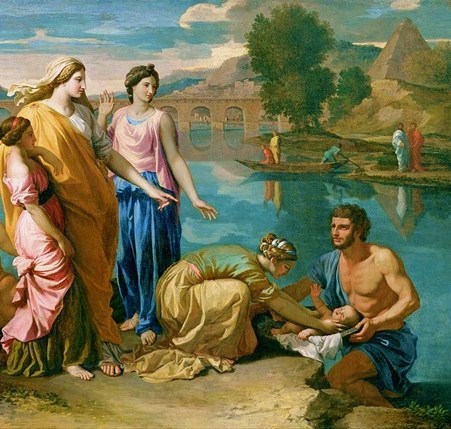
The painting is "Baby Moses Rescued From the Nile" by Nicolas Poussin, in 1638. Those Egyptian women sure do look white.

Verse 10 makes it seem as though Moses means "out of the water". Moses is basically the same name as Rameses. Ra-meses. Ra is the god name, meses means "born of". So Moses was named "born of the god..." (insert god name here). My belief on Moses name is this: Moses originally had a different name, possibly named after the god of the Nile, Hapi, making his name Hapimesses. Later on, when he became a follower of Jehovah, he would have changed his name to Jehovahmesses. Except that they aren't to use god's name like that, so he changed his name to Moses, "born of the god who shouldn't be named".

11And it came to pass in those days, when Moses was grown, that he went out unto his brethren, and looked on their burdens: and he spied an Egyptian smiting an Hebrew, one of his brethren.

12And he looked this way and that way, and when he saw that there was no man, he slew the Egyptian, and hid him in the sand.

At what point did Moses find out he was a Hebrew and not Egyptian. He may have found out in the shower in Egyptian gym class, when he noticed he was circumcised and none of the other Egyptian boys were.

Word of Moses killing the Egyptian got around.

15Now when Pharaoh heard this thing, he sought to slay Moses. But Moses fled from the face of Pharaoh, and dwelt in the land of Midian: and he sat down by a well.

Midian was one of the sons of Abraham through Keturah. The area would have been named after him.

16Now the priest of Midian had seven daughters: and they came and drew water, and filled the troughs to water their father's flock.

17And the shepherds came and drove them away: but Moses stood up and helped them, and watered their flock.

18And when they came to Reuel their father, he said, How is it that ye are come so soon to day?

Moses assumes that he's helping the correct people.

19And they said, An Egyptian delivered us out of the hand of the shepherds, and also drew water enough for us, and watered the flock.

20And he said unto his daughters, And where is he? why is it that ye have left the man? call him, that he may eat bread.

21And Moses was content to dwell with the man: and he gave Moses Zipporah his daughter.

So Moses moves in with Reuel, the father of Zipporah. Reuel means "god is his friend", Reu-el.

22And she bare him a son, and he called his name Gershom: for he said, I have been a stranger in a strange land.

Moses has a son, Gershom. Gershom means "a sojourner there". Imagine naming your child, "not born at home".

Pharaoh dies, God suddenly remembers his kids.

Exodus 3

1Now Moses kept the flock of Jethro his father in law, the priest of Midian: and he led the flock to the backside of the desert, and came to the mountain of God, even to Horeb.

Reuel is now named Jethro. Jethro means "his excellence".

2And the angel of the LORD appeared unto him in a flame of fire out of the midst of a bush: and he looked, and, behold, the bush burned with fire, and the bush was not consumed.

Yippie, the burning bush.

3And Moses said, I will now turn aside, and see this great sight, why the bush is not burnt.

Moses said, "dude, a burning bush, awesome, I gotta see this".

4And when the LORD saw that he turned aside to see, God called unto him out of the midst of the bush, and said, Moses, Moses. And he said, Here am I.

5And he said, Draw not nigh hither: put off thy shoes from off thy feet, for the place whereon thou standest is holy ground.

Take off your shoes, this is holy ground. I'm not sure how much cleaner feet would be than shoes. Especially if they are sandals.

6Moreover he said, I am the God of thy father, the God of Abraham, the God of Isaac, and the God of Jacob. And Moses hid his face; for he was afraid to look upon God.

If Moses was raised as an Egyptian, would he know who these people are? One of the previous pharaoh's didn't know Joseph, why would Moses (raised an Egyptian) know the history of the slave people?

7And the LORD said, I have surely seen the affliction of my people which are in Egypt, and have heard their cry by reason of their taskmasters; for I know their sorrows;

8And I am come down to deliver them out of the hand of the Egyptians, and to bring them up out of that land unto a good land and a large, unto a land flowing with milk and honey; unto the place of the Canaanites, and the Hittites, and the Amorites, and the Perizzites, and the Hivites, and the Jebusites.

These are the people I will displace. The Canaanites, the Hittites, the Amorites, the Perizzites, the Hivites, and the Jebusites. (The Jebusites are my favorite).

10Come now therefore, and I will send thee unto Pharaoh, that thou mayest bring forth my people the children of Israel out of Egypt.

God's going to send Moses to the pharaoh.

11And Moses said unto God, Who am I, that I should go unto Pharaoh, and that I should bring forth the children of Israel out of Egypt?

Moses tried to be humble (more on that later). He didn't want to do it. He was happy as a shepherd out in Midian. He didn't need the hassle of going back to Egypt.

13And Moses said unto God, Behold, when I come unto the children of Israel, and shall say unto them, The God of your fathers hath sent me unto you; and they shall say to me, What is his name? what shall I say unto them?

14And God said unto Moses, I AM THAT I AM: and he said, Thus shalt thou say unto the children of Israel, I AM hath sent me unto you.

It's god speaking, not Popeye. If it were Popeye, he'd say "I yam, WHAT I yam" not "I AM THAT I AM". You'll not that I AM is in all caps. That's because it's one of the names of god. Additionally, LORD is routinely printed in all caps, that's because LORD is also one of the formal names of the god of the bible. Normally, LORD is replacing Yahweh (YHWH).

15And God said moreover unto Moses, Thus shalt thou say unto the children of Israel, the LORD God of your fathers, the God of Abraham, the God of Isaac, and the God of Jacob, hath sent me unto you: this is my name for ever, and this is my memorial unto all generations.

When I was a child at Sky Lodge Christian Camp, one time I heard one of the counselors say "God's last name isn't damnit". He never really took into account that god's first name isn't "god".

16Go, and gather the elders of Israel together, and say unto them, The LORD God of your fathers, the God of Abraham, of Isaac, and of Jacob, appeared unto me, saying, I have surely visited you, and seen that which is done to you in Egypt:

17And I have said, I will bring you up out of the affliction of Egypt unto the land of the Canaanites, and the Hittites, and the Amorites, and the Perizzites, and the Hivites, and the Jebusites, unto a land flowing with milk and honey.

Land of Milk and Honey, not "The Land of Rape and Honey"


18And they shall hearken to thy voice: and thou shalt come, thou and the elders of Israel, unto the king of Egypt, and ye shall say unto him, The LORD God of the Hebrews hath met with us: and now let us go, we beseech thee, three days' journey into the wilderness, that we may sacrifice to the LORD our God.

The people are to say that they are just going to go on a three day trip to do some sacrifices to their god. Then, just keep going.

19And I am sure that the king of Egypt will not let you go, no, not by a mighty hand.

20And I will stretch out my hand, and smite Egypt with all my wonders which I will do in the midst thereof: and after that he will let you go.

God knows that Egypt won't let them go, he wants to do the plagues.

21And I will give this people favour in the sight of the Egyptians: and it shall come to pass, that, when ye go, ye shall not go empty.

22But every woman shall borrow of her neighbour, and of her that sojourneth in her house, jewels of silver, and jewels of gold, and raiment: and ye shall put them upon your sons, and upon your daughters; and ye shall spoil the Egyptians.

Not only will they let you go, they'll give you all their gold so that you leave.

Points to ponder:

1. Where would Moses learn about Abraham, Isaac, Jacob? Granted Jethro could (and probably did) teach him about Abraham, but the Isaac and Jacob story wouldn't be part of his heritage.

2. How did the Egyptians never figure out Moses wasn't the son of the Pharaoh's daughter? Did they not notice that she was never pregnant?

3. Why is Reuel renamed to Jethro?

4. How did the Canaanites, Hittites, Armorites, Perizzites, Hivites, and the Jebusites survive the 7 year famine?

5. Unless Al Jourgensen changes his mind, you won't be able to see Ministry again. Revolting Cocks has been passed on to Josh, Clayton and Sin. He's got to get back together with Jello to finish up Lard. I'm not sure if he has any plans for the other side projects. Oh and Fix, the Ministry Movie, comes out this summer.

Saturday, January 16, 2010

Day 16. Genesis 47-50

Genesis 47-50

Genesis 47

1Then Joseph came and told Pharaoh, and said, My father and my brethren, and their flocks, and their herds, and all that they have, are come out of the land of Canaan; and, behold, they are in the land of Goshen.

Goshen was some of the (but not the) best land in Egypt. It's in the north east of the country. The name Goshen doesn't really mean anything. The area is now a desert.

Joseph presents five of his brothers to pharaoh.

3And Pharaoh said unto his brethren, What is your occupation? And they said unto Pharaoh, Thy servants are shepherds, both we, and also our fathers.

Darn it; Joseph said they were supposed to say cattle ranchers because shepherding is an abomination.

7And Joseph brought in Jacob his father, and set him before Pharaoh: and Jacob blessed Pharaoh.

There wasn't always contention between the Hebrews and the Egyptians.

8And Pharaoh said unto Jacob, How old art thou?

9And Jacob said unto Pharaoh, The days of the years of my pilgrimage are an hundred and thirty years: few and evil have the days of the years of my life been, and have not attained unto the days of the years of the life of my fathers in the days of their pilgrimage.

Ok, if Jacob is 130, that means that it is 1766.

11And Joseph placed his father and his brethren, and gave them a possession in the land of Egypt, in the best of the land, in the land of Rameses, as Pharaoh had commanded.

Ramesses means "Born of the god Ra". Messes means "born of the god". Amenmesse means "born of the god Amun".

13And there was no bread in all the land; for the famine was very sore, so that the land of Egypt and all the land of Canaan fainted by reason of the famine.

The famine was getting worse. The first two years, there was still plenty. Now, things are getting pretty bad.

14And Joseph gathered up all the money that was found in the land of Egypt, and in the land of Canaan, for the corn which they bought: and Joseph brought the money into Pharaoh's house.

First, Joseph managed to get all the money from the people, in exchange for corn.

15And when money failed in the land of Egypt, and in the land of Canaan, all the Egyptians came unto Joseph, and said, Give us bread: for why should we die in thy presence? for the money faileth.

The famine (with the help of Joseph) ruined the economy of Egypt.

16And Joseph said, Give your cattle; and I will give you for your cattle, if money fail.

17And they brought their cattle unto Joseph: and Joseph gave them bread in exchange for horses, and for the flocks, and for the cattle of the herds, and for the asses: and he fed them with bread for all their cattle for that year.

After Joseph took all the money from the land. He then took all the livestock, in exchange for corn. Why didn't these people ever eat their livestock? Jacob and all his people came down with a whole lot of livestock. Why didn't they eat it? Does no one eat cows? Oh yeah, probably not.

And now, for a discussion of Astrological Ages. Each age is roughly 2000 years.

We are currently (or just about to go into) the Age of Aquarius. Yes, like the musical Hair says, "this is the dawning of the Age of Aquarius". The astrological ages proceed backwards from the order of the zodiac. We haven't gotten our great messiah for this age yet (I'll do it). Aquarius would last from about 2000-4000 AD.

The age that is either ending, or just ended was the age of Pisces. The great messiah for that age was Jesus. The symbol of Pisces is a fish. One of the symbols that people use to represent Jesus is the Ichthus (the Jesus fish). (pronounced Ikh-thoos) It is the greek word for fish. Pisces would have lasted from about 0-2000 AD.

The age before that was the Age of Aries. Aries is the ram. The great messiah for that age was Moses. Moses is often depicted with rams horns, known as Horned Moses, (we'll get to more of that in a couple of days). Remember, Isaac was about to be sacrifice, and then a ram was stuck in the bushes and it was sacrificed instead. Isaac was born in 1956, right at the beginning of the age of Aries. Aries would have been from 0-2000 BC.

The age before that was Taurus. Taurus is the bull. That era would have been from 2000-4000 BC (the first day). Bulls were sacred animals in Egypt during this time. So people wouldn't have eaten them.

So, since they were at the end of the age of Taurus, the people wouldn't eat their sacred animals.

Back to the bible.

18When that year was ended, they came unto him the second year, and said unto him, We will not hide it from my lord, how that our money is spent; my lord also hath our herds of cattle; there is not ought left in the sight of my lord, but our bodies, and our lands:

19Wherefore shall we die before thine eyes, both we and our land? buy us and our land for bread, and we and our land will be servants unto Pharaoh: and give us seed, that we may live, and not die, that the land be not desolate.

Joseph has the money, the livestock, and now he's taking the land and the people.

20And Joseph bought all the land of Egypt for Pharaoh; for the Egyptians sold every man his field, because the famine prevailed over them: so the land became Pharaoh's.

21And as for the people, he removed them to cities from one end of the borders of Egypt even to the other end thereof.

He turned the farming civilization into people who lived in cities. He didn't buy the land of the priests. After purchasing the land, he allowed people to go farm on it, in return for 20% of the harvest.

26And Joseph made it a law over the land of Egypt unto this day, that Pharaoh should have the fifth part, except the land of the priests only, which became not Pharaoh's.

Apparently the bible is correct, from what I can tell, Egypt currently has a progressive income tax rate from 20 to 40 percent.

27And Israel dwelt in the land of Egypt, in the country of Goshen; and they had possessions therein, and grew, and multiplied exceedingly.

28And Jacob lived in the land of Egypt seventeen years: so the whole age of Jacob was an hundred forty and seven years.

Jacob is preparing to die.

29And the time drew nigh that Israel must die: and he called his son Joseph, and said unto him, If now I have found grace in thy sight, put, I pray thee, thy hand under my thigh, and deal kindly and truly with me; bury me not, I pray thee, in Egypt:

30But I will lie with my fathers, and thou shalt carry me out of Egypt, and bury me in their buryingplace. And he said, I will do as thou hast said.

31And he said, Swear unto me. And he sware unto him. And Israel bowed himself upon the bed's head.

This is another testicle/ballsack/circumcision swear. "Under my thigh" means the testes, or on the circumcision.

Either way, Jacob didn't want to be buried in Egypt (he's a racist), he wanted to be buried in the cave of the patriarchs.

Genesis 48

Jacob takes his two boys in to see their grandfather and be blessed.

5And now thy two sons, Ephraim and Manasseh, which were born unto thee in the land of Egypt before I came unto thee into Egypt, are mine; as Reuben and Simeon, they shall be mine.

As Reuben and Simeon, they shall be mine. What Jacob means is, INSTEAD of Reuben and Simeon, they shall be mine. Jacob was still pissed at Reuben for sleeping with Bilhah. Jacob was pissed at Simeon for killing all the people in Shechem.

8And Israel beheld Joseph's sons, and said, Who are these?

What? In the 17 years that Jacob lived in Israel, he never met Joseph's boys?

In recent reading we saw how the notions of Benjamin were incorrect. How he's portrayed as a child of around 10 years old when he meets Joseph in Egypt. Meanwhile he moves down into Egypt with 10 children. Today we get another example of how people get it wrong.

The picture to the right is Jacob Blessing Ephraim and Manasseh, by Benjamin West. This was painted in 1766-68. The picture hangs in the Allen Memorial Art Museum, Oberlin College, Oberlin, Ohio.

You see Jacob, an old man, blessing two young children. Manasseh is the darker haired child.

In Genesis 41:50, we see the sons were born before the years of famine. Jacob moved into Egypt in the second year of the famine. Jacob dies after living there for 17 years. Jacob dies after giving the blessings. The boys would have been nearly 20, and not children.

9And Joseph said unto his father, They are my sons, whom God hath given me in this place. And he said, Bring them, I pray thee, unto me, and I will bless them.

Joseph introduces his sons.

12And Joseph brought them out from between his knees, and he bowed himself with his face to the earth.

This verse makes it seem as though the boys were children. We'll have to keep reading to ensure that they are men, and not young boys.

13And Joseph took them both, Ephraim in his right hand toward Israel's left hand, and Manasseh in his left hand toward Israel's right hand, and brought them near unto him.

14And Israel stretched out his right hand, and laid it upon Ephraim's head, who was the younger, and his left hand upon Manasseh's head, guiding his hands wittingly; for Manasseh was the firstborn.

Ephraim got the right hand (so he'd be the blond child in the painting).

15And he blessed Joseph, and said, God, before whom my fathers Abraham and Isaac did walk, the God which fed me all my life long unto this day,

16The Angel which redeemed me from all evil, bless the lads; and let my name be named on them, and the name of my fathers Abraham and Isaac; and let them grow into a multitude in the midst of the earth.

God bless these boys.

17And when Joseph saw that his father laid his right hand upon the head of Ephraim, it displeased him: and he held up his father's hand, to remove it from Ephraim's head unto Manasseh's head.

18And Joseph said unto his father, Not so, my father: for this is the firstborn; put thy right hand upon his head.

It's funny that Jacob wants his sons blessed in their birth order. He's usurping his oldest brothers blessing, by getting his boys blessed first. He's also getting the primary blessing from the son who usurped it from the deserving brother (Esau). Who got his blessing from the father who sent away his firstborn (Ishmael) to go die in the desert.

19And his father refused, and said, I know it, my son, I know it: he also shall become a people, and he also shall be great: but truly his younger brother shall be greater than he, and his seed shall become a multitude of nations.

The younger sons always seem to be the ones who are greater.

22Moreover I have given to thee one portion above thy brethren, which I took out of the hand of the Amorite with my sword and with my bow.

I don't remember that story.

Genesis 49

1And Jacob called unto his sons, and said, Gather yourselves together, that I may tell you that which shall befall you in the last days.

Jacob calls his sons together. It's time for them to be blessed.

First he insults Reuben, for sleeping with his concubine. (1)

4Unstable as water, thou shalt not excel; because thou wentest up to thy father's bed; then defiledst thou it: he went up to my couch.

Then he insults Simeon and Levi, for killing Shechem.(2,3)

7Cursed be their anger, for it was fierce; and their wrath, for it was cruel: I will divide them in Jacob, and scatter them in Israel.

Judah is the first to get something nice said to him. (4)

8Judah, thou art he whom thy brethren shall praise: thy hand shall be in the neck of thine enemies; thy father's children shall bow down before thee.

Zebulon: (5)

13Zebulun shall dwell at the haven of the sea; and he shall be for an haven of ships; and his border shall be unto Zidon.

Issachar: (6)

14Issachar is a strong ass couching down between two burdens:

Dan: (7)

16Dan shall judge his people, as one of the tribes of Israel.

Gad: (8)

19Gad, a troop shall overcome him: but he shall overcome at the last.

Asher: (9)

20Out of Asher his bread shall be fat, and he shall yield royal dainties.

Naphtali: (10)

21Naphtali is a hind let loose: he giveth goodly words.

Joseph: (11)

22Joseph is a fruitful bough, even a fruitful bough by a well; whose branches run over the wall:

Benjamin: (12)

27Benjamin shall ravin as a wolf: in the morning he shall devour the prey, and at night he shall divide the spoil.

It seems like some of those are just the ravings of a dieing man. They don't seem like blessings at all.

28All these are the twelve tribes of Israel: and this is it that their father spake unto them, and blessed them; every one according to his blessing he blessed them.

Those are the blessings.

Then he demanded to be buried in the cave of the patriarchs.

33And when Jacob had made an end of commanding his sons, he gathered up his feet into the bed, and yielded up the ghost, and was gathered unto his people.

Then he died.

Exactly when did all the blessings take place? We know the final blessings happened in 1749, right before he died. The narrative seems to imply that the 12 blessings happened almost directly after the Manasseh/ Ephraim blessings. Which would put it at 17 years after Jacob went to Egypt, making those two boys nearly 20.

Genesis 50

1And Joseph fell upon his father's face, and wept upon him, and kissed him.

2And Joseph commanded his servants the physicians to embalm his father: and the physicians embalmed Israel.

This is the first mention of embalming. There is only one other Hebrew who was embalmed, and that's later, in verse 26.

Joseph tells Pharaoh that he wants to go bury his dad at the cave of the patriarchs.

Pharaoh lets him go.

12And his sons did unto him according as he commanded them:

13For his sons carried him into the land of Canaan, and buried him in the cave of the field of Machpelah, which Abraham bought with the field for a possession of a buryingplace of Ephron the Hittite, before Mamre.

Jacob was buried next to Leah. Rachel was buried someplace else. Jacob may have loved Rachel more, but the person he was buried with was Leah.

14And Joseph returned into Egypt, he, and his brethren, and all that went up with him to bury his father, after he had buried his father.

The brothers went back. The famine was over. They didn't need to go back. They could have stayed, if they did, we wouldn't have a whole lot of the religions that are out there now. There would have been no exodus. There wouldn't be the plagues. There wouldn't be passover. Jesus wouldn't have been sacrificed on passover.

The brothers are then afraid that Joseph will now punish them. They thought that maybe he was being nice because of Jacob.

17So shall ye say unto Joseph, Forgive, I pray thee now, the trespass of thy brethren, and their sin; for they did unto thee evil: and now, we pray thee, forgive the trespass of the servants of the God of thy father. And Joseph wept when they spake unto him.

Joseph was sad that they thought he would do them harm.

20But as for you, ye thought evil against me; but God meant it unto good, to bring to pass, as it is this day, to save much people alive.

21Now therefore fear ye not: I will nourish you, and your little ones. And he comforted them, and spake kindly unto them.

Joseph promises to take care of his brothers families.

22And Joseph dwelt in Egypt, he, and his father's house: and Joseph lived an hundred and ten years.

23And Joseph saw Ephraim's children of the third generation: the children also of Machir the son of Manasseh were brought up upon Joseph's knees.

Joseph actually took part in the lives of his grand children. Which is odd, since no one else seems to have taken an interest in their grandkids. Noah cursed one of his. Jacob blessed Ephraim and Manasseh, but didn't know who they were. No one seemed to care about anyone except their favorite.

26So Joseph died, being an hundred and ten years old: and they embalmed him, and he was put in a coffin in Egypt.

Joseph finally died.

Thus ends Genesis.

Points to ponder:

1. Is it right to take all the money, then take the livestock, then take the land, then take the people? If the stored food was a fifth, didn't the people have a right to the food they put up?

2. We Manasseh and Ephraim children, or were they in their late teens?

3. Why did they go back to Egypt after burying Jacob?